An infectious virus titer for lot release in 24 hours, in TiterKinetix
A 45-second loop of a kinetic infectivity assay in TiterKinetix for oncolytic viruses, viral vaccines and other virus-based therapeutics: a plate with your reference standard and samples, time-lapse images from the plate imager you already own, automated detection of infection-induced changes in cell morphology, configurable kinetic curve fitting, and an infectious virus titer for lot release 24 hours after infection instead of 5 to 10 days.
1 / 6 · Release
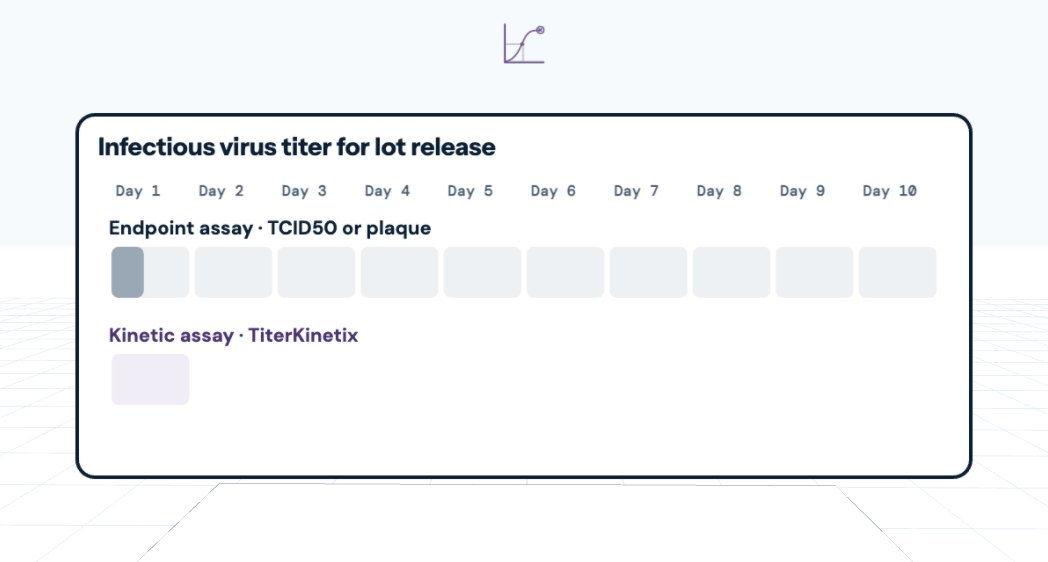
Infectious virus titers in 24 hours, not 5 to 10 days.
Endpoint infectivity assays such as TCID50 and plaque assays hold up lot release for days. A kinetic infectivity assay reports in 24 hours.
Infectious virus titers for lot release and stability testing of virus-based therapeutics in 24 hours, not 5 to 10 days, from the plate imager you already own. Under 20% CV from three wells.
Book a demo at totallab.comYour software won’t do what you need? Ask TotalLab.
Lot release in 24 hours
Infectivity is a critical quality attribute for oncolytic viruses, viral vaccines and other virus-based therapeutics, yet endpoint infectivity assays such as TCID50 and plaque assays take 5 to 10 days while cytopathic effect (CPE) develops. A kinetic infectivity assay follows infection as it happens and gives an infectious virus titer 24 hours after infection, so lot release and stability decisions come days sooner.
Your plate, your standard
Set up the plate your way: a reference standard dilution series on every plate, your controls, and samples infected at a single dose in as few as three wells instead of a full serial dilution, so one plate carries many samples. 96- and 384-well formats are supported.
The imager you already own
TiterKinetix works with almost any automated plate imager that captures time-lapse images, including the Agilent BioTek Cytation 5 and the Sartorius Incucyte family. Use bright-field, phase contrast or fluorescence at the interval you choose, with no specialist reagents required.
Infection-induced changes in cell morphology
TiterKinetix finds and classifies the cells in every image and measures the infection-induced change in cell morphology in each well at every timepoint, such as cell rounding or other early cytopathic effects. It suits any virus and cell line combination where infection causes a change you can image, with no manual microscopy and no subjective CPE scoring.
Kinetic fit to titer
Kinetic curves, configurable by the user, are fitted across all timepoints in every well, so the whole time course counts rather than a single endpoint. Samples are interpolated against the reference standard curve on the same plate and reported in the units of your reference standard, such as TCID50/mL or PFU/mL, with under 20% CV from three wells.
Release and stability, under Part 11
The kinetic readout is stability-indicating, so the same assay serves lot release and stability programs. With AuditSafe, every step from the raw images to the signed release report sits under 21 CFR Part 11 and GMP controls, with audit trail, electronic signatures and user access control.
“Our kinetic infectious virus titer (KIT) assay is stability-indicating and, due to its sensitive readout method, provides results within 24 h post-infection.”
Hotter, D., Kunzelmann, M., et al. (2024). Int. J. Mol. Sci., 25, 8076. doi:10.3390/ijms25158076
See TiterKinetix on your own virus, cells and plate imager, for oncolytic viruses, viral vaccines and other virus-based therapeutics and ATMPs, in process development, formulation, lot release and stability testing. Built on published kinetic infectivity science and developed with pharmaceutical scientists working on viral therapeutics. Working under GMP? AuditSafe adds 21 CFR Part 11 and Annex 11 controls.
Book a demo