
Why AI Can't Write Your Life Science Software (And When It Actually Can)
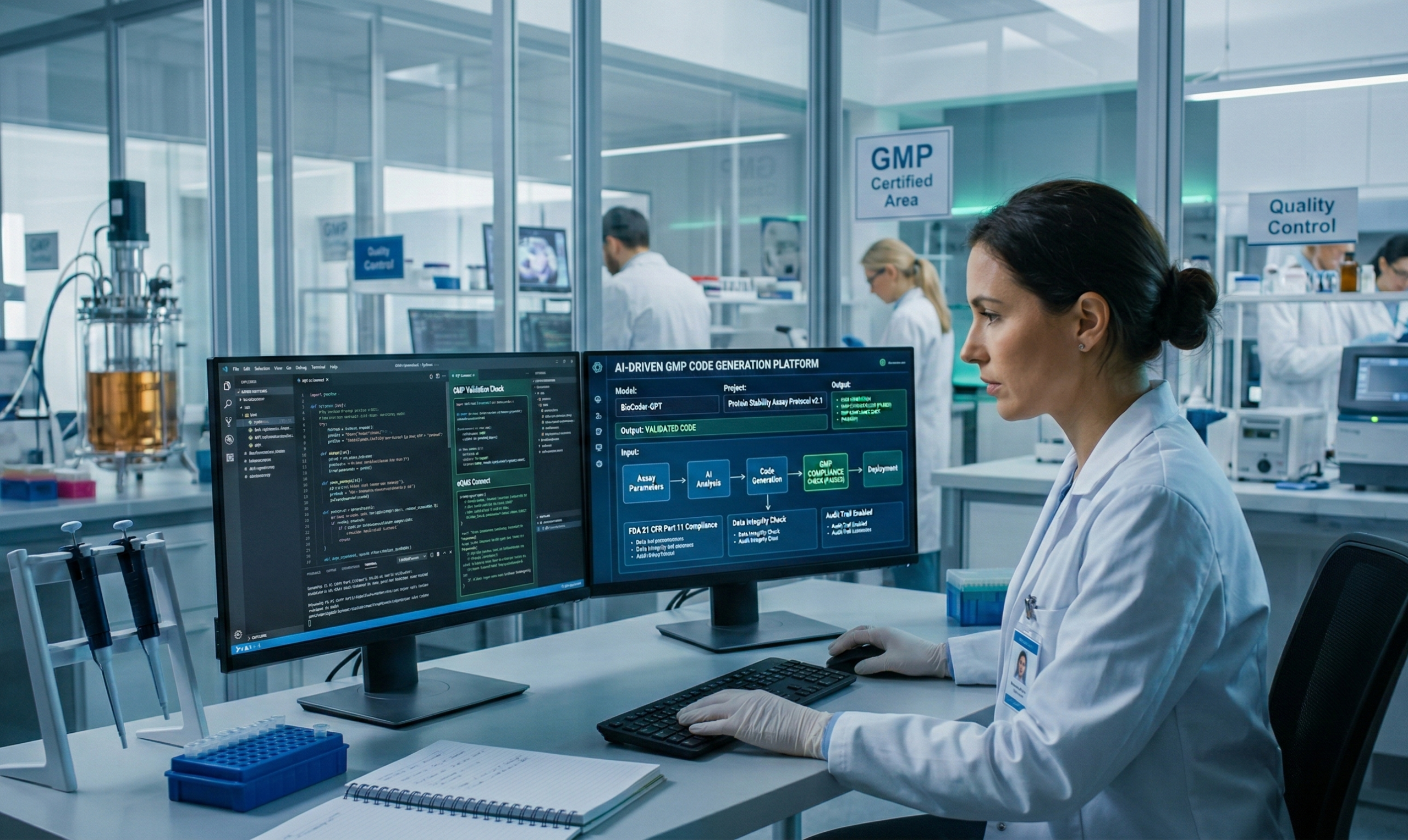
Speak with any Lab Director or CTO in the life sciences today, and the conversation inevitably turns to Generative AI. As Large Language Models (LLMs) become increasingly capable of generating code, a tempting question arises: Can we bypass traditional software developers and use AI to build our next laboratory tool or compliant product?
It is an appealing thought. However, life science software is fundamentally different from generic consumer apps. In the lab, software doesn’t just process data; it dictates regulatory compliance, protects intellectual property, and ensures patient safety.
While AI code generation is a powerful accelerant for certain tasks, treating it as a replacement for experienced software engineering in a regulated environment is a massive operational risk. Here is TotalLab’s guide to navigating AI in life science software – where it truly adds value, and where human expertise remains absolutely non-negotiable
Where AI Code Generation Shines in Life Science Software
When the stakes are low and the environment is strictly non-regulated (non-GxP), an LLM can be an incredible asset for your R&D or IT teams. We actively encourage the use of AI for:
- Rapid Wireframing and UI Mockups: If your team has a concept for a new analytical workflow, an AI can generate an interactive prototype in minutes. At TotalLab, we actually leverage this methodology during client consultations. It allows us to quickly visualize a customer’s idea, iterate on the design collaboratively, and lock in the interface before our engineers write the actual production code.
- Single-Use Data Scripts: Laboratories frequently need to reformat raw data – such as writing a quick Python script to convert an instrument’s CSV output into a clean Excel file. For these low-risk, one-off utilities that do not touch sensitive patient data or require validation, AI is a massive time-saver.
If a tool is temporary, internal, and sits entirely outside the scope of regulatory audits, generative AI is a highly effective shortcut.
Why AI Code Generation is a Liability for Regulated Lab Software
The moment software enters a commercial lab, a GMP manufacturing facility, or a 21 CFR Part 11 environment, the “quick fix” of AI generation turns into severe technical and legal debt.
Here is why relying on AI for core product development in the life sciences is a critical liability:
1. Compliance is a Legal Framework, Not a Coding Standard
LLMs are trained to write functional code, not to pass an FDA audit. Regulatory mandates like 21 CFR Part 11 or EU Annex 11 require deep, architectural controls around electronic signatures, role-based access, and ALCOA+ data integrity.
An AI might write a basic login screen, but it does not understand the legal necessity of tying that login to a biometric Windows Active Directory, nor does it know how to generate an unalterable, time-stamped background audit trail. Compliance requires human experts who understand why the rules exist and how regional data sovereignty laws dictate where that data can legally be stored.
2. The 20-Year Lifecycle of Lab Software
AI models prioritize speed and surface-level correctness. They do not plan for how a system will scale, how it handles unexpected edge-case data from a malfunctioning spectrometer, or how it will be maintained a decade from now.
In the life sciences, longevity is everything. At TotalLab, our domain experts frequently assist customers with support queries for software we developed over two decades ago. AI-generated code is notoriously difficult to maintain over long periods because it often patches together outdated or inconsistent patterns scraped from millions of public repositories. Experienced engineers design systems to last; AI designs systems for right now.
3. Unseen Security Risks to IP and Patient Data
In the pharmaceutical and biotech sectors, security vulnerabilities can result in stolen intellectual property or compromised patient data. Because LLMs are trained on vast amounts of unvetted public code, they frequently reproduce known security flaws.
Security cannot be treated as a plugin added at the end of development. It must be woven into the core architecture of the software by developers who understand threat modeling in highly networked, enterprise lab environments.
The TotalLab Approach: Amplifying Expertise with AI
The organizations that will lead the next decade of life science innovation are not the ones trying to replace their developers with AI. The winners will be those who use AI to amplify the capabilities of proven engineers – speeding up the boilerplate work so humans can focus on rigorous system design, regulatory compliance, and future-proofing.
For over 20 years, TotalLab has specialized in building and securing life science software. We understand the nuances of GMP requirements, quality management systems, and the strict demands of global equipment manufacturers.
Are you looking to build compliant software or secure your existing instruments? Whether you need a custom solution or want to explore our 21 CFR Part 11/GMP-compliant OEM services, contact the TotalLab team today to explore how we can support your journey to market safely and efficiently.