
Private, explainable AI that your QA team can validate, from development teams who have been building life science software since 1989.
TotalLab builds custom AI for pharmaceutical and biotech labs: image analysis models, machine learning for QC, and private language model tools that run on your own infrastructure. Each system is developed with audit trails and validation documentation, so it can move from pilot into a GxP environment instead of stalling at proof of concept.
Where AI pays off in the lab
AI earns its place where people repeat the same judgment many times a day. These are the projects we build most often.
AI image analysis
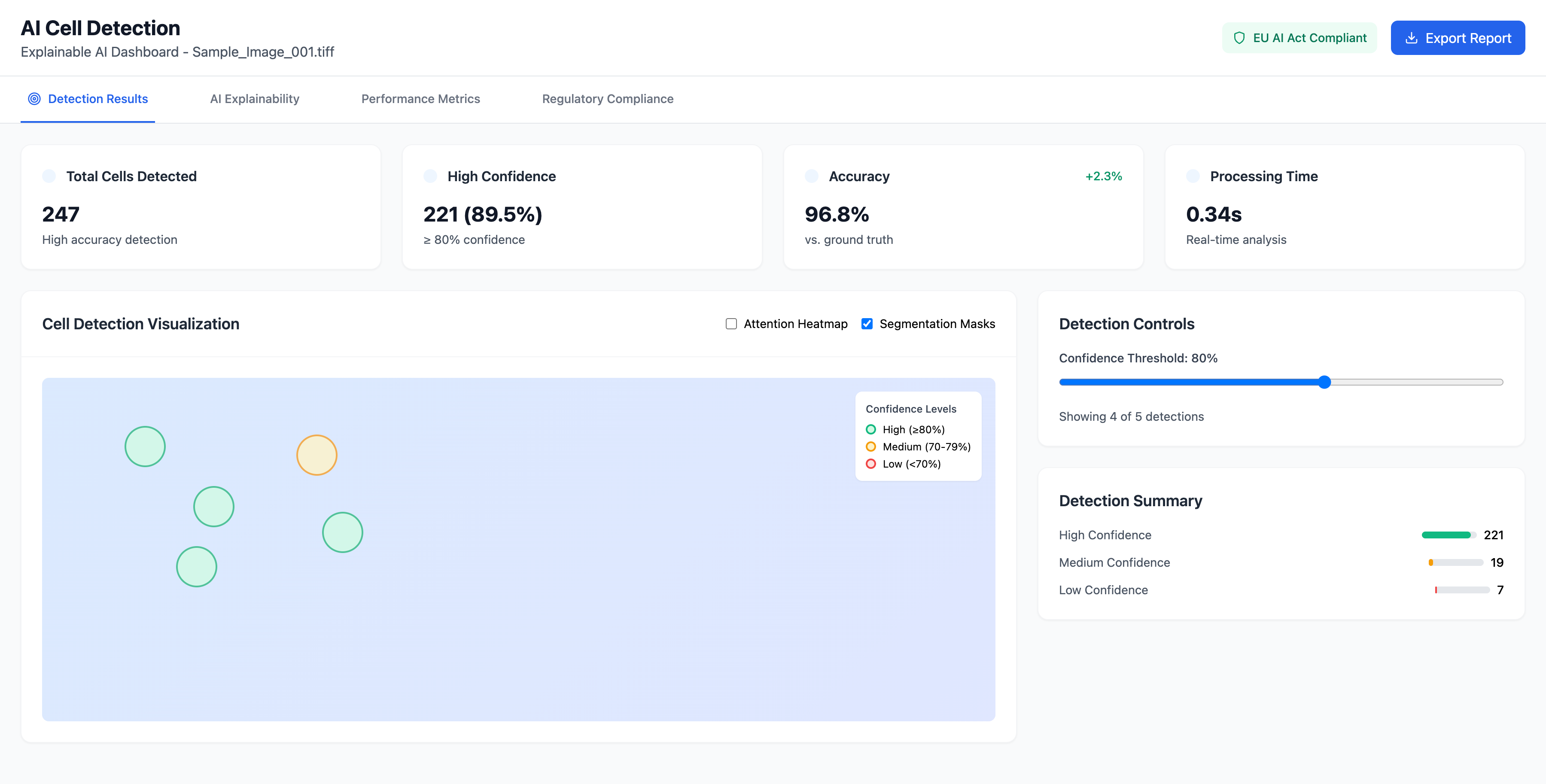
Detection and measurement for microscopy, gels, blots and colony plates, with every result open to review and correction by the scientist.
Machine learning for QC and QA
Flag out-of-trend results, classify deviations and spot drift in assay data before it becomes an investigation.
AI-driven workflow automation
Route data from instruments to LIMS to reports without manual transcription, with the model’s decisions logged.
Computer vision for lab automation
Vision systems integrated with instruments and LIMS for inspection and sample handling.
Private language model tools
Knowledge retrieval, report drafting and protocol assistance that run on your infrastructure, trained on and limited to your documents.
GxP decision support
Recommendation tools that keep a qualified person in the loop and record who accepted what, and when.
How custom image analysis software is built, and where machine learning helps →
Private AI for biotech and pharma: your data stays yours
Most AI tools send your data to someone else’s servers. Ours do not have to. We build and train models on your proprietary data inside your own environment, whether that is an on-premises server, a private cloud tenancy or an air-gapped network. Data governance agreements are standard on every project.
That matters twice in pharma: once for protecting R&D data, and again at inspection, when you need to show exactly what data trained the model and where it lives.
Making lab instrument data AI-ready
AI projects in large pharma organizations rarely fail on the model. They fail on the data. Instrument output arrives in different formats, with metadata in file names, spreadsheets and people’s heads. Before any model is trained, that data has to be consistent, attributable and complete.
We start every AI engagement with a data readiness review. We map where instrument data is produced, how it is named and stored, which metadata is missing, and what ALCOA+ gaps would block a validated model. Then we build the pipeline that standardizes it. The output is useful even if the AI project pauses: clean, traceable data your existing reports can use too.
Validating AI in a GxP environment
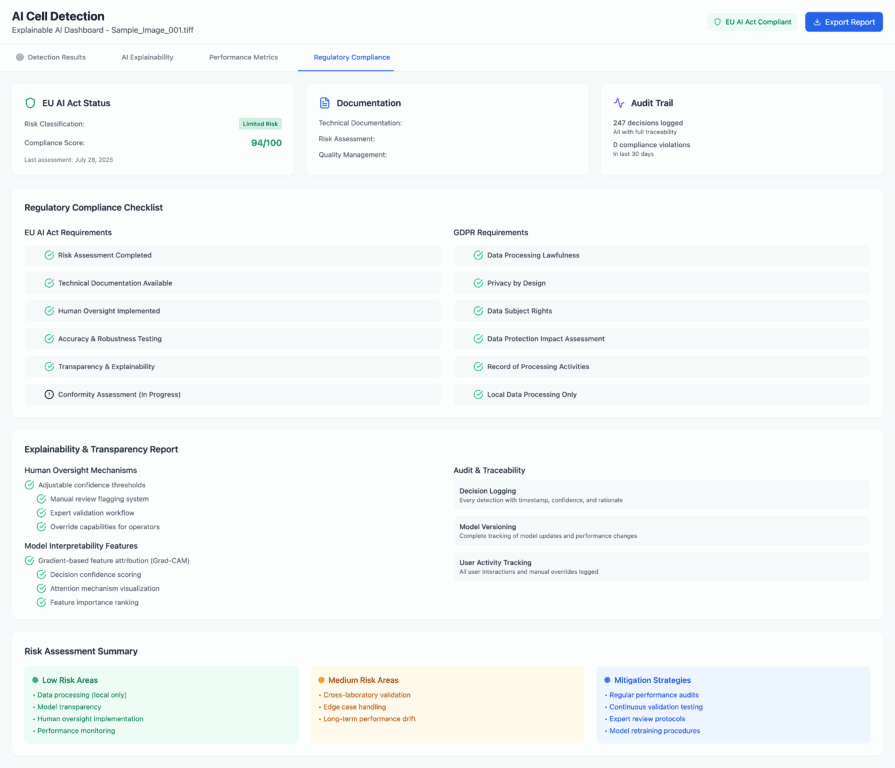
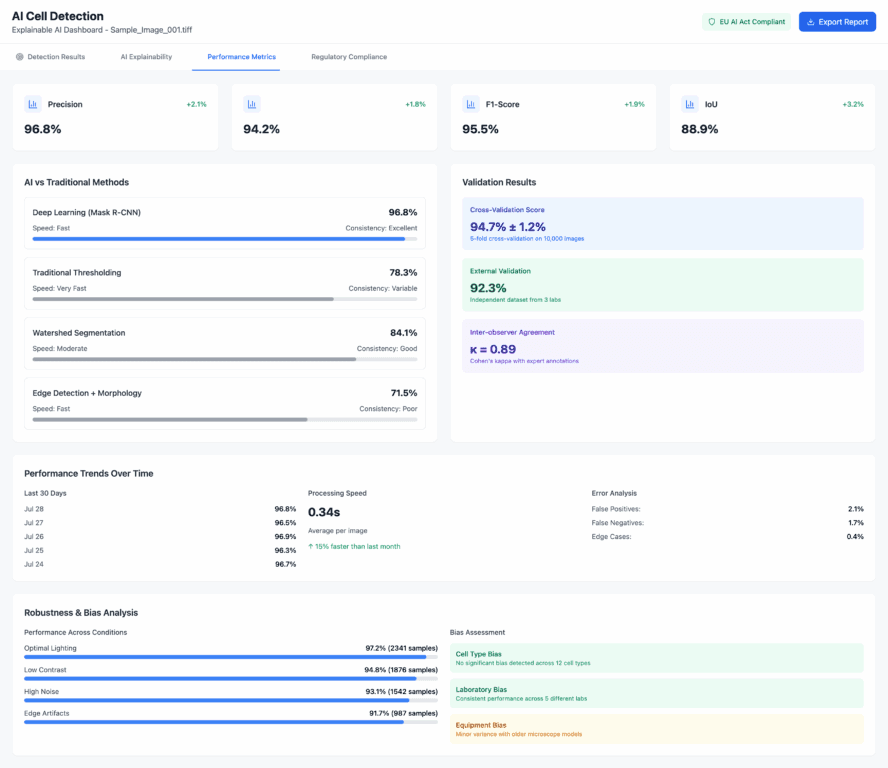
Can AI-powered lab software comply with FDA and GxP regulations? Yes, when it is designed for it. Regulators expect the same things from an AI system that they expect from any computerized system: a defined intended use, a risk-based validation, controlled changes and a full audit trail. AI adds two more: the model’s behavior has to be explainable, and retraining has to be a controlled change, not a silent update.
We design for this from the start. Models are versioned and locked for release. Every prediction is logged with the model version that produced it. Systems follow a development lifecycle aligned with GAMP 5 principles and the FDA’s Computer Software Assurance guidance, support IQ/OQ/PQ, and are risk-classified against the EU AI Act.
Case study: AI-assisted colony counter
Our first case study involved taking an existing piece of TotalLab software, our Phoretix Colony Counter, and using AI and machine learning to remove the manual steps users had to go through to detect colonies within an image:

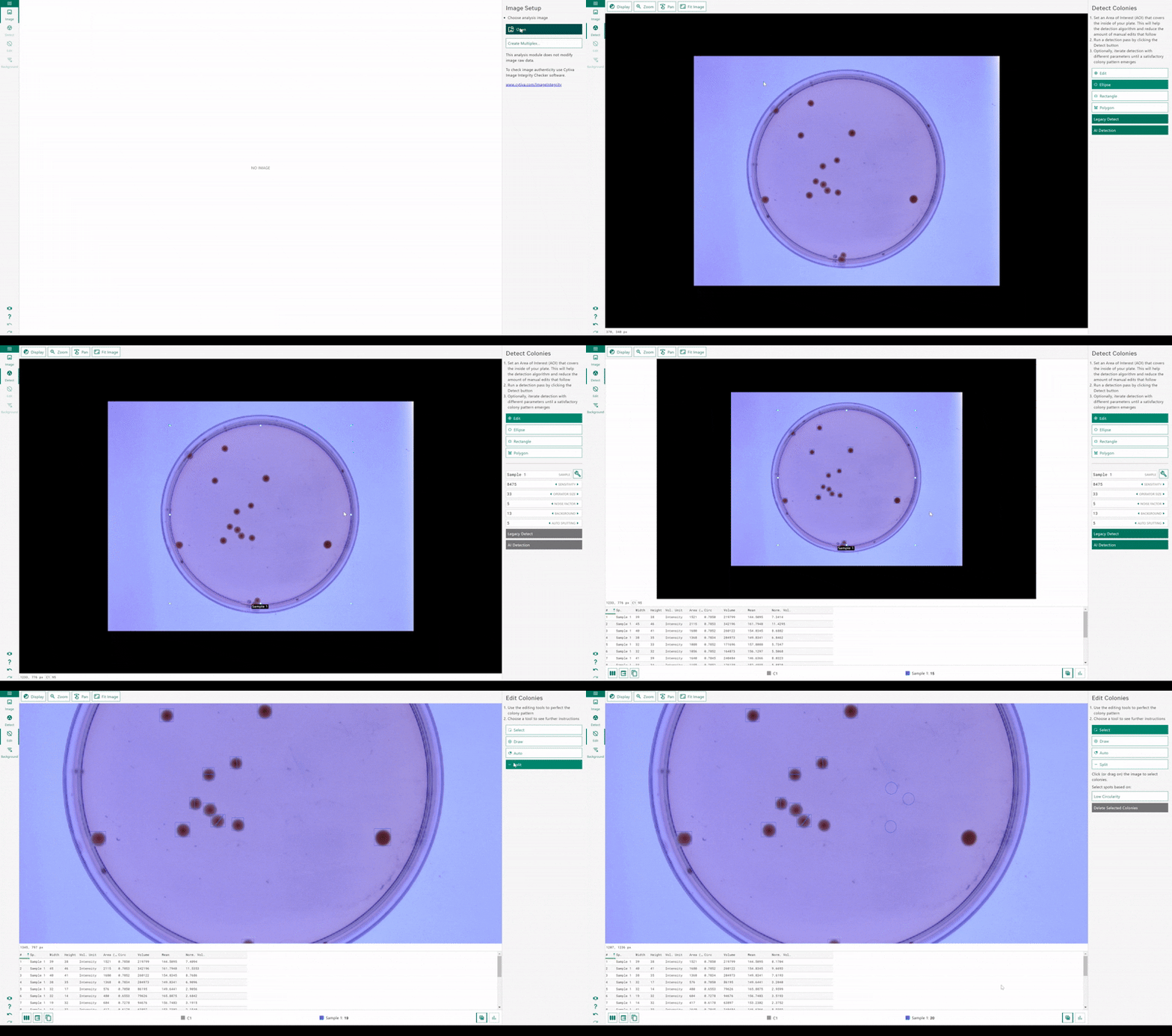
As you can see above, enhancement of this particular product with AI and ML allowed us to massively reduce user intervention, and therefore the time taken for analysis, and to remove a source of potential inter-operator variability. The result? More reliable results, quicker.
As you can also see above, each detected colony can be interacted with and adjusted, and additional colonies can be manually added after detection, allowing users to fine-tune the analysis if they want to. AI enhancement is provided as a tool, but manual intervention still remains possible.
How to choose a custom AI partner for pharma
Four questions separate a pharma-ready AI partner from a general AI agency. Ask them before you sign.
Have they shipped software into a GMP lab? A strong demo on public data says little about whether the result will survive validation. Ask for a regulated deployment you can talk to.
How will the model be validated and changed? Ask to see what a validation package looks like, and how retraining is controlled after go-live.
Can they explain a single prediction? If the vendor cannot show why the model made a specific call, your QA team will not be able to either.
Do they understand the science? An agency that has to learn what a western blot or a colony plate is will spend your budget doing it. Our development teams have built lab image analysis software since Phoretix 1D in 1993.
How an AI project runs
We know pharma and biotech projects have tight governance, defined budgets and real regulatory consequences. Our process is built around that reality.
Step 1: Discovery and scoping. We start by understanding your workflow, your data and your compliance environment. You’ll leave with a clear picture of what’s possible and a proposed approach before any commitment is made.
Step 2: Prototype and validate. We build a working prototype rapidly, so you can see your solution in action early and give your feedback. This keeps you in control of direction and budget, and surfaces any technical or compliance considerations before full build begins.
Step 3: Build and integrate. Full development follows, with regular check-ins, transparent progress, and continuous integration with your existing systems, instruments and data infrastructure.
Step 4: Validation and deployment. We deliver validated, audit-ready software with complete documentation, with IQ/OQ/PQ support available where required. Handover includes documentation and staff training. See what a validation package should contain.
Most projects reach a working prototype in roughly 6 to 10 weeks from scoping, and full production deployment 3 to 6 months after that.
Who we work with
Pharmaceutical companies. From top-10 global pharma to mid-size specialty manufacturers. We help R&D, QC and digital transformation teams build AI that meets their internal governance requirements and external regulatory obligations.
Biotech and CRO organizations. Fast-moving teams who need capable, scalable AI tooling without the overhead of building an in-house software function. We act as your embedded development partner.
Medical device and diagnostics companies. AI-enabled image analysis, decision-support and data management tools built to IEC 62304 and relevant MDR/IVDR standards.
TotalLab is a registered supplier on Scientist.com, making procurement straightforward for R&D teams at large pharma organizations.
Need software that does not involve AI? See our custom pharmaceutical software development services for data workflows, Part 11 databases and instrument software.
Frequently asked questions
What does custom AI development for life sciences involve?
It covers the full process of designing, building, testing and deploying artificial intelligence or machine learning software tailored to your specific workflows, data and regulatory environment. Unlike off-the-shelf AI tools, a custom build means the solution is built around your processes, not the other way around.
How do you ensure AI software is GxP and 21 CFR Part 11 compliant?
Compliance is built into our development process from the start, not bolted on at the end. This means designing for full audit trails and electronic records from day one, following a development lifecycle aligned with GAMP 5 principles, and producing IQ/OQ/PQ-ready documentation throughout. We also keep pace with evolving FDA and EMA guidance on AI and machine learning in regulated environments.
Do you work with our existing data and infrastructure?
Yes. We design solutions to integrate with your existing LIMS, instruments, data warehouses and IT infrastructure. We also build AI models trained on your proprietary data, keeping it within your environment throughout.
How long does a custom AI development project take?
Timelines vary by scope, but most projects move from initial scoping to a working prototype within 6 to 10 weeks. Full production deployment typically follows within 3 to 6 months. The data readiness review usually comes first. We'll give you a clear timeline estimate during your free consultation.
Why choose TotalLab over a general AI software development agency?
General agencies bring coding skills but rarely understand the regulatory, scientific or data context of life science work. TotalLab's team combines software engineering with domain expertise in GxP compliance, assay data, image analysis and pharma QC workflows. That means less time educating us and more time building the right solution. See the four questions above for what to ask any AI partner.
What happens to our data during development?
Your data remains under your control throughout. We can develop and test entirely within your infrastructure, and we do not retain or transfer proprietary data outside of agreed boundaries. Data governance agreements are standard on all projects.
Is AI-powered lab software compliant with FDA and GxP regulations?
It can be, if it is designed for compliance from the start. That means a defined intended use, risk-based validation, version-locked models, logged predictions and controlled retraining. We follow a development lifecycle aligned with GAMP 5 principles and the FDA's Computer Software Assurance guidance, and provide IQ/OQ/PQ support.
Start with a free AI consultation
Whether you have a specific project in mind or just know you need to “do something with AI,” we can help. Tell us about your lab, your data and the decision you want to speed up, and we’ll tell you honestly whether AI is the right tool.
Resources
Validating Custom Software: GAMP 5, CSA and What You Should Receive From Your Developer
How GAMP category 5 software is validated under FDA's 2025 CSA guidance: the lifecycle, IQ, OQ and PQ, the documents a developer should deliver, validating AI components, and keeping the software validated after release.
Read More >
How Custom Image Analysis Software for the Lab Is Built: From Assay to Validated Tool
The five steps from assay to validated tool: defining the measurement, surveying the variation, choosing the algorithm, proving accuracy on real data and building the software around it, plus where machine learning helps and where it does not.
Read More >
Why AI Can't Write Your Life Science Software (And When It Actually Can)
Generative AI is rapidly changing the lab, but can it write your next compliant product? Discover the right - and wrong - times to use AI code generation in life science software, and why human expertise remains absolutely vital for GMP compliance and data security.
Read More >
How AI Can Transform Modern Pharma QC Environments
Discover how AI-powered, digital CQV platforms help pharma QC teams replace paper-based validation with compliant, data-driven workflows. Learn how to reduce review time, prevent deviations earlier, and align with 21 CFR Part 11 and EU Annex 11.
Read More >
TotalLab joins Scientist.com as a trusted custom software and OEM development partner for big pharma
TotalLab has joined Scientist.com as a trusted custom software and OEM development partner for big pharma, making it simpler for R&D, QC and digital teams to procure compliant, lab‑ready software.
Read More >
How to Navigate AI 21 CFR/GMP Compliance
Explore essential AI compliance steps, including EU AI Act and UK regulations, risk assessment, transparency, and data governance. This guide helps organizations understand how TotalLab can help you create responsible, legally compliant AI systems with practical actions and expert insights.
Read More >