SpotMap MS: Automated LC-MS Host Cell Protein (HCP) Analysis Software for Biologics

SpotMap MS logo, TotalLab's automated LC-MS host cell protein (HCP) analysis software
Click Here For Your Free Trial Copy!

SpotMap MS identifies and quantifies host cell proteins (HCPs) in biotherapeutics from LC-MS data, from DIA or DDA acquisitions, without an analyst having to drive the search. Point it at your FASTA file and your raw mass spec files and it produces a complete HCP report automatically, highlights the HCPs that peer-reviewed literature has linked to product or patient risk, assigns each a threat level, and keeps a record of what an analyst has verified.

It is built for regulated biopharma. Paired with AuditSafe it runs under 21 CFR Part 11, GMP and EU Annex 11 controls (audit trails, electronic signatures, granular permissions, data authenticity checks), and TotalLab supplies in-person IQ/OQ validation packages with regulated licenses. It was developed in collaboration with the world’s largest pharmaceutical companies and the BEBPA Host Cell Protein Conference community.

"Typically with proteomics-based software to search against the CHO proteome, we don’t have much functionality to validate spectra. As a result, the output becomes (here is a list of proteins we identified and their relative abundance), if we wanted to validate those matches it could easily take twice as long without SpotMap MS”

Industry Collaborator

Why LC-MS HCP Analysis Needed Purpose-Built Software

SpotMap MS solves current challenges preventing the wide scale adoption of HCP analysis via LC-MS:

  • Complex software. Difficult to drive and time-consuming, preventing users from performing the routine calibration and maintenance they need to do to guarantee accuracy within their specific LC-MS equipment
  • Software designed for Proteomics. Current LC-MS analysis software is designed for large-scale proteomic use, not for identifying HCPs. It’s over complicated for the task at hand when you really want to answer a simple question – does my sample contain HCPs? and if so, are they dangerous?
  • Lack of reproducibility. Other software packages focus on dealing with many different research questions, and to do so require large numbers of parameters. This compromises the reliability of that data as it is too easy for different users to get different answers. SpotMap MS is designed from a “QC first” perspective designed to align with best practices in the field of HCP analysis.
  • Lack of automation. Despite the maturity of LC-MS as an analytical technique, data analysis still remains a time-intensive and laborious process. SpotMap MS is designed as a “set it and forget it” solution automating your analysis and dropping you straight into a comprehensive HCP report once completed.
  • Very few 21 CFR/GMP-compliant options. The limitations listed above have so far been a barrier to LC-MS’s adoption within regulated environments, with very few manufacturers supporting 21 CFR/GMP-compliance, limiting user choice. SpotMap MS is fully compatible with our AuditSafe software to achieve 21 CFR/GMP-compliance built by the industry, for the industry.

The software has been developed in collaboration with and in response to pharmaceutical industry feedback and the world’s leading experts in HCP analysis from the BEBPA Host Cell Protein Conference of which TotalLab has been a long time supporter.

It is easy to master, with accurate results obtained quickly and reproducibly.

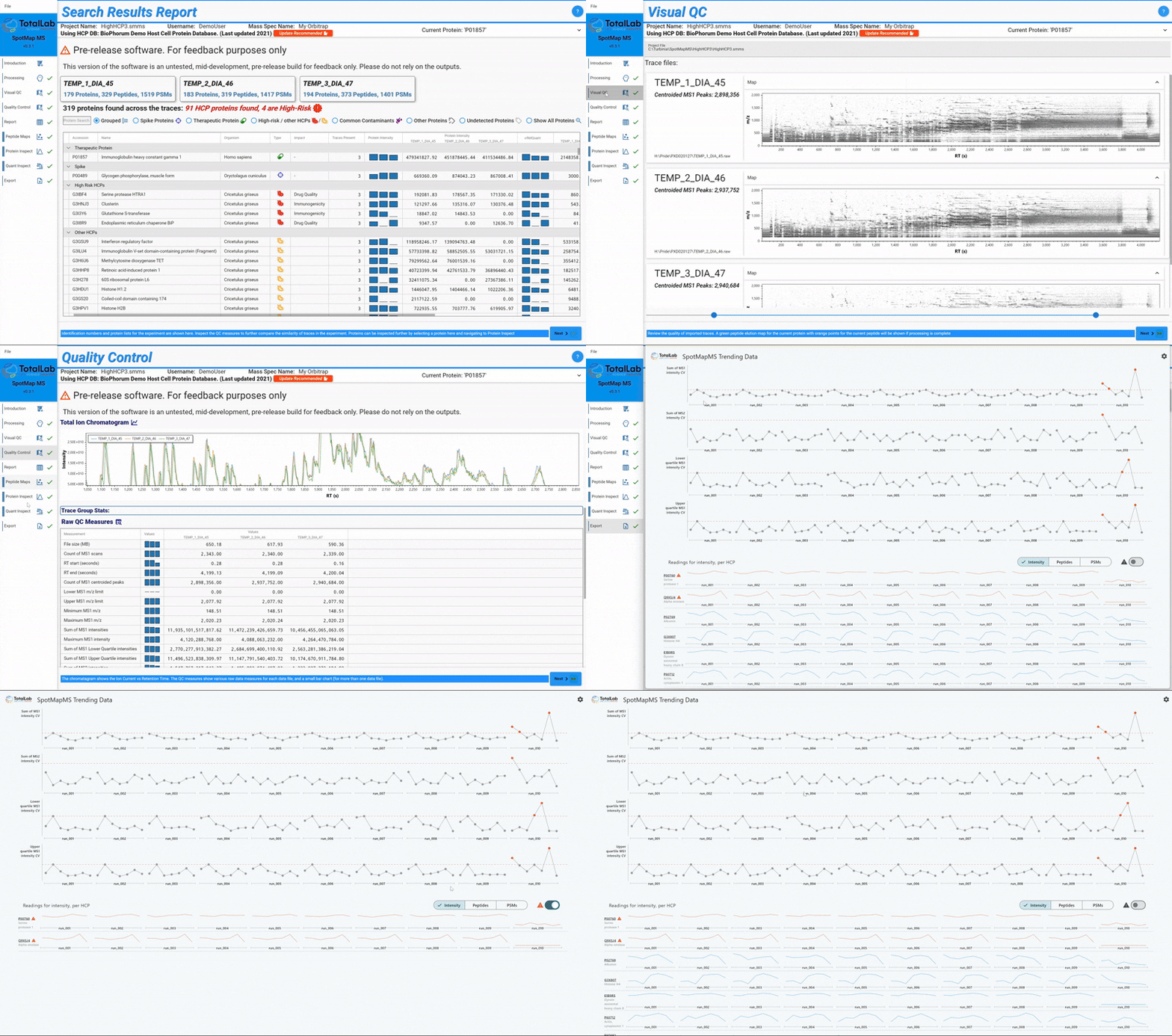
SpotMap MS protein inspection interface displaying HCP analysis results with MS1 MS2 spectra and automated host cell protein identification from LC-MS data

"Without SpotMap MS and it's Visual QC functionality we didn't even realize one of our technical replicates had failed - our current software had no way of showing us and we spent hours analyzing bad data that we could have immediately detected using SpotMap MS"

Industry Collaborator

Why Choose SpotMap MS for HCP Identification and
Quantification by LC-MS

SpotMap MS is specifically designed from the ground up to automatically analyze LC-MS traces for host cell proteins – rather than being repurposed proteomics based software like competitor solutions. It does this by searching LC-MS data against a user-provided FASTA file, and it accepts both data-independent acquisition (DIA) and data-dependent acquisition (DDA) runs, so it fits the method your lab already runs rather than forcing a change of acquisition mode. This allows users to either import their own, proprietary, existing spectral library of identified host cell proteins or use a commercially or publicly available one.

SpotMap MS also includes TotalLab’s AI powered HCP identity spectral library that includes associated HCP threat level, so even if you’re just getting started in the world of LC-MS based HCP analysis you won’t be working blind.

SpotMap MS has been built and continues to be developed in direct contact with the world’s largest pharmaceutical companies performing this work on a day to day basis. By working with the world’s leading experts on LC-MS HCP analysis TotalLab has created a software tool developed for scientists, by scientists.

Each HCP is reported in relative units as determined by label-free Hi3 quantitation against spiked-in standard proteins, the relative-to-spiked-in-protein approach described in USP <1132.1>, with peptide-level evidence for every identification. High-risk HCPs, the lipases and other problematic proteins the literature names, are flagged from the built-in threat-level database (BioPhorum HCP database is also supported), so the report answers the two questions that matter: which HCPs are present? and are any of them dangerous? It is orthogonal to your HCP ELISA, not a replacement for it. See how HCP ppm is calculated from LC-MS data.

How to report SpotMap MS in your methods: “HCPs were identified and quantified from [DIA/DDA] LC-MS data in SpotMap MS (TotalLab Ltd, Newcastle upon Tyne, UK) by label-free Hi3 quantitation against spiked-in standard proteins and reported in relative quantity”

High-Risk HCP Detection: Sensitive Search, Filtered Report

As SpotMap MS is designed from the ground up for HCP analysis, rather than adapting an existing piece of proteomics software for the task, it works slightly differently to other software in this space. We set our analysis parameters (for example, false discovery rate (FDR)) to be extremely sensitive automatically within the software and then filter the HCPs we detect using our proprietary database of already identified potentially dangerous HCPs.

This shows you everything – no data reduction or hidden data behind the scenes. Any host cell proteins we even suspect of being being both present and risky we highlight to the user. From there, we then provide facilities for the user to manually verify those hits as quickly and comprehensively as possible. We’ve put a lot of effort into making this verification process fast and reliable, with a guided step through of everything you’ll be reporting on, and a record of what has been inspected so you can show regulators that it has all had human eyes on verification.

We take this approach of risking generating false positives (and being able to eliminate those quickly within the software) as we believe that it is far preferable to do it this way than to risk false negatives – the risk of a dangerous HCP “getting through” undetected.  This is because HCPs such as enzymes can cause serious problems even when only present in vanishingly small amounts (which could be close to the limits of detection of your LC-MS system).

And because you don’t need to worry about HCPs that have not been reported in the literature as potentially dangerous, the human effort required to make this happen is much less than you might imagine.

Animated dashboard view showing how SpotMap MS and TrendLab software work together to track longitudinal Host Cell Protein (HCP) concentrations across multiple LC-MS samples, highlighting high-risk proteins and data trends in pharmaceutical QC workflows

Automated, Hands-Free HCP Analysis of LC-MS Data

SpotMap MS is designed to be as automated as possible to fit in with your life and your workflow. This allows you to save as much time as possible when analyzing LC-MS traces, through advanced “hands-off” automation that allows you to “set and forget” your analysis through to unique upfront data visualization, allowing you to make a quick upfront decision as to whether a dataset is worth investing analysis time into. If a technical error has occurred in processing, you still have time to prepare a new sample to be analyzed, rather than only realizing at the end and wasting huge amounts of time and potentially your sample.

SpotMap MS achieves this by allowing a user to assign a “watched” folder. As soon as traces hit that folder they’re automatically analyzed per a set of pre-configured parameters by the user.

There’s also provision for the software to restart an automated analysis at the last place it reached just in case anything should happen to the computer mid-operation. No more being chained to your desk waiting for your analysis to finish!

Automated SpotMap MS software interface for LC-MS host cell protein analysis, showing folder monitoring setup for hands-free HCP data processing

Data Quality and USP 1132.1 Peptide-Level Verification

As Scientists, we want to be confident that we are investigating real trends and ensuring our data is of a high standard is central to this. Being warned early about acquisition failures saves users both time and money. SpotMap MS has a strong focus on making data quality checks automatic and easy to to perform. A new, comprehensive method known as the Protein Verification Loop has been developed by TotalLab specifically for SpotMap MS to ensure that your entire analysis is reliable; from raw data all the way to protein quantification.

This kind of process is specifically mentioned in the latest regulatory guidance, USP General Chapter <1132.1> states: “Search engine output should not be trusted implicitly, especially for low-abundance HCPs”. “Manual inspection of peptide-level raw data (XIC trace, MS spectrum, and MS/MS spectrum) should be a routine part of HCP data analysis process”

SpotMap MS builds this inspection into the workflow: every reported HCP carries a record of which peptides were reviewed, by whom and when, so the verification step is evidence rather than a claim.

Our data quality metrics guide user actions, are easy to interpret and ensure that users at all experience levels can be effective software users and HCP mass spec experts without extensive training.

In other words: the methods and experience of an expert in HCP detection via LC-MS is now codified in an application for you to use

 Metrics measured using this method can be used in System Suitability Testing, method development and to characterize the behavior of your HCPs in your mass spectrometer over time.

SpotMap MS Quality Control interface displaying Total Ion Chromatogram and comprehensive raw QC measures for HCP analysis data validation and USP 1132.1 compliance

Built-In High-Risk HCP Database, Free with Every License

Integration with a Host Cell Protein safety-profile database saves users research time and facilitates prioritization of potentially dangerous HCPs.

As mentioned above, SpotMap MS includes TotalLab’s AI powered HCP identity spectral library that includes associated HCP threat level, so even if you’re just getting started in the world of LC-MS based HCP analysis you won’t be working blind.

This database has been generated with the latest techniques in AI, evolves over time and lists the known current threat level of HCPs.

Or if you have your own existing HCP database you wish to use, SpotMap MS also supports integration of existing datasets.

SpotMap MS HCP safety-profile database interface showing AI-powered host cell protein threat levels and integration with custom LC-MS datasets

Longitudinal HCP Trending with TrendLab

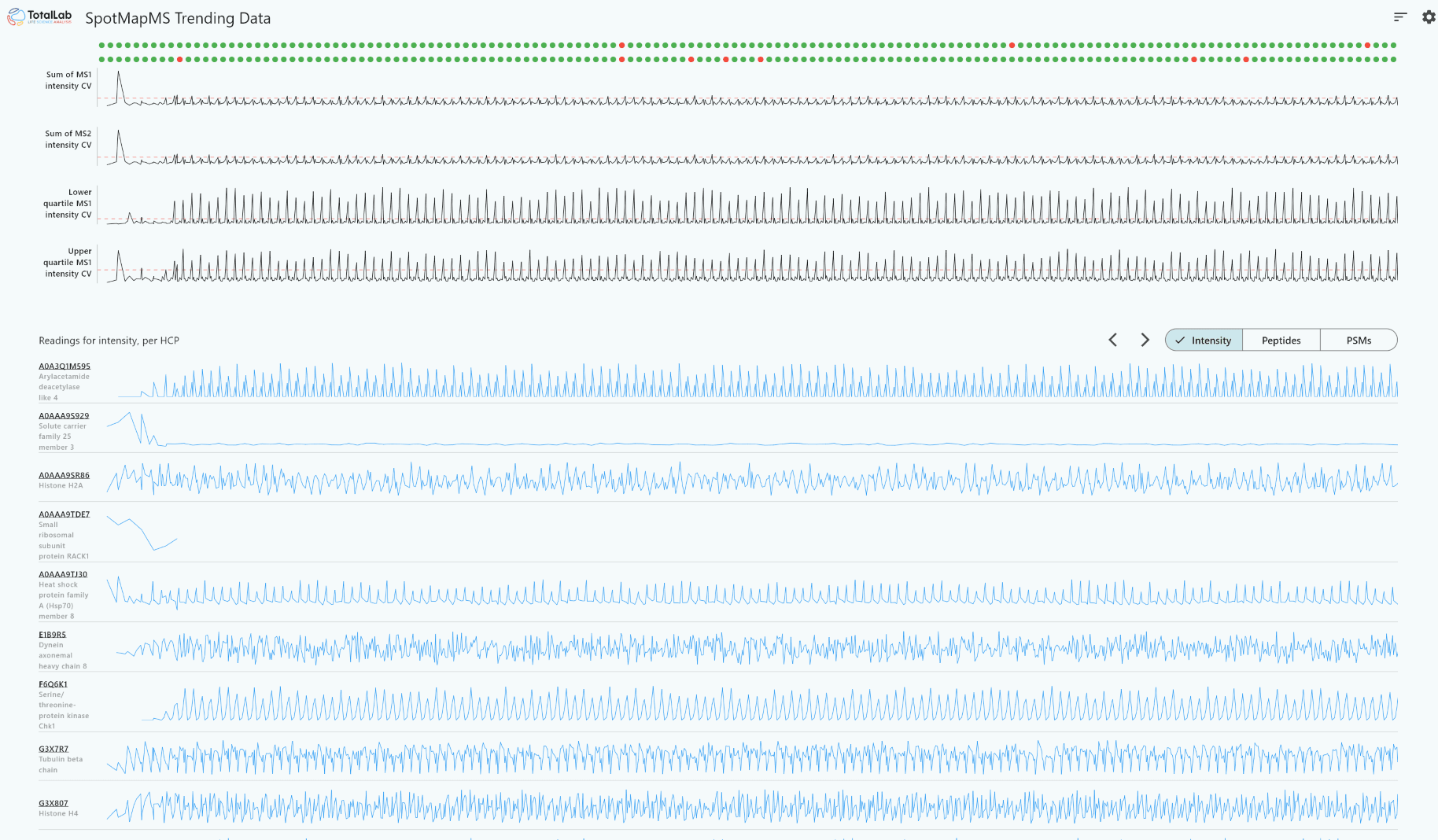
SpotMap MS experiments can be tracked over time with TrendLab, another exciting new product from TotalLab that enables longitudinal tracking of your MS experiments. This extended functionality allows you to:

  • Track your system suitability tests before and after each run, maintaining a long term record of your equipment health, setup and calibration.
  • Monitor HCP content across multiple runs and observe any changes in HCP content that might indicate issues or changes in your workflow
  • Share HCP content data across different departments on-site to track purification processes
SpotMap MS Trendlab integration dashboard showing longitudinal tracking of MS1 and MS2 intensity CVs and host cell protein intensity trends across multiple LC-MS runs

Validated, Regulated LC-MS HCP Software: 21 CFR Part 11, EU Annex 11 and GMP

SpotMap MS, along with all TotalLab software, can be integrated into our 21 CFR Part 11/GMP-compliant AuditSafe software to provide audit trails, electronic signatures, granular user permissions and data authenticity verification for FDA 21 CFR
Part 11 and EU Annex 11 in regulated GMP environments (such as the pharmaceutical industry) where data traceability, accountability, and integrity are critical.

AuditSafe restricts software and data access through secure user sign-ins, granular permissions, audit trails, electronic signatures and data authenticity checks. Click here to find out more.

IQ/OQ Validation Packages for Regulated Use

At TotalLab, we’ve been supporting the world’s largest pharmaceutical companies with highly secure, production-ready versions of our software for over a decade now and enjoy very good relationships across the industry.

We know the importance of properly validated software and how it forms part of your QC journey so we offer a full, in-person IQ/OQ package to accompany the sale of regulated versions of our software

21 CFR Compliance

SpotMap MS Case Studies: Johnson & Johnson and the Total HCP Project (click to enlarge)

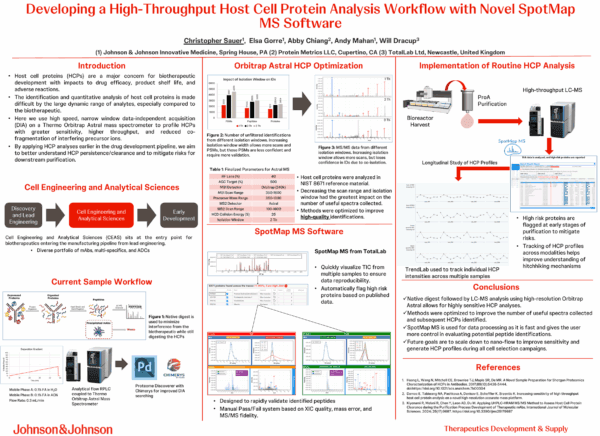
Developing a High-Throughput Host Cell Protein Analysis Workflow with Novel SpotMap MS Software – Presented at CASSS Mass Spectrometry Conference 2025

Johnson and Johnson HCP LC-MS Analysis Software

“Spotmap MS is used for data processing as it is fast and gives the user more control in evaluating potential peptide identifications”

Chris Sauer, Johnson & Johnson

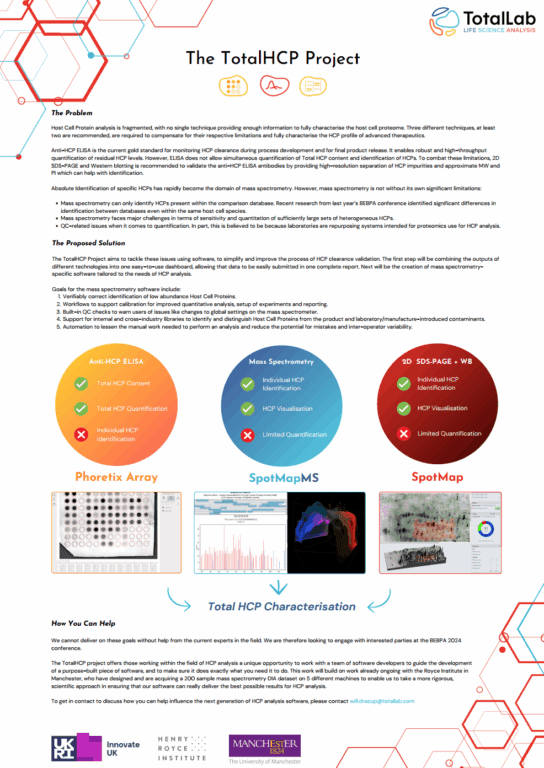
The Total HCP Project with Novel SpotMap MS Software – Presented at BEBPA HCP Conference 2024

TotalHCP project - Total host cell protein Characterisation

SpotMap MS Licensing: Single Computer, Multi-Seat or Enterprise

At TotalLab we’ve been working with pharmaceutical and academic life science customers for decades, we know that some of our users prefer offline licensing to enhance security within their sites. This isn’t a problem, all TotalLab software can be activated easily either online or offline.

Our licensing system licenses a whole computer at once, with no restrictions on the number of users who have access to the software on that computer.

Licenses can be purchased singularly for one computer or we also offer discounts on multiple license purchases at the same time if you want to cover multiple computers across your site; enabling hybrid working to perform analysis outside of the lab or to allow multiple analyses to happen at the same time.

We can also support enterprise licensing for full site-wide licenses covering large pharmaceutical manufacturing facilities and research facilities at a significant discount vs buying singular or multiple licenses.

For pricing and any other licensing related queries please contact us.

Support and Maintenance

At TotalLab, we’re the trusted partner of some of the world’s largest pharmaceutical companies, so we understand the importance of support and maintenance contracts for software, especially in time-critical and high-value processes.

We take pride in offering the highest level of support and educational resources to all of our customers. Our team of PhD-educated life science experts are dedicated to ensuring that you have the best experience possible all whilst understanding the scientific principles behind your experiments. Pricing for unlimited technical support, training and free updates to the software are included in your license cost – one fee, complete peace of mind. You’ll always be eligible for the latest version of the software on the latest operating systems so there’s no fear of future operating system incompatibility or running insecure, outdated software for critical operations.

We never use call centers or ticketing systems – when you need support you’ll speak directly to a member of the TotalLab team. We understand your time is valuable, which is why we aim to resolve your queries as quickly as possible, ensuring minimal disruption to your workflow.

In addition to our exceptional support, we also offer a range of educational resources. Our extensive library of tutorials and guides will provide you with the knowledge you need to use our software effectively. Whether you are a seasoned professional or a newcomer, our resources will ensure that you have the skills you need to succeed.

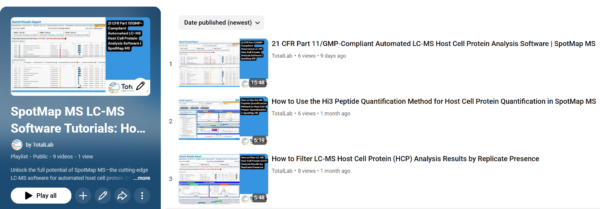
You can access our video tutorials here:

SpotMap MS video tutorial playlist on the TotalLab YouTube channel

If you have a question about using our software, you can email support@totallab.com and a member of our team will be in touch to help you.

How to Purchase

The best way to ensure you’re purchasing the latest version of SpotMap MS with the highest level of technical support is directly from us here at TotalLab by using the contact us form. We can accept payment in GBP (£), USD ($) or EUR (€).

SpotMap MS FAQs

Q: What is SpotMap MS used for?
A: SpotMap MS is software for LC-MS based host cell protein (HCP) analysis in biologics. It automates HCP identification and quantitation from mass spectrometry data, supporting process development and QC labs in pharma and biotech.

Q: Does SpotMap MS support USP <1132.1>?
A: Yes. SpotMap MS is designed to support alignment of LC-MS HCP workflows with USP <1132.1>, and pairs with AuditSafe from TotalLab to provide a 21 CFR Part 11 ready setup.

Q: Does SpotMap MS integrate with the BioPhorum HCP database?
A:Yes. SpotMap MS integrates with the BioPhorum HCP database, allowing labs to work with shared industry HCP reference data within their LC-MS analysis workflow.

Q: Who uses SpotMap MS?
A: SpotMap MS is used by pharmaceutical and biotech researchers performing HCP impurity analysis for biologics. Case studies, posters, and testimonials are available on the TotalLab website.

Q: Does SpotMap MS support DIA and DDA data?
A: Yes. SpotMap MS processes both data-independent acquisition
(DIA) and data-dependent acquisition (DDA) LC-MS data for host cell
protein identification and quantification, so you can keep the
acquisition method already qualified on your instrument.

Q: Is SpotMap MS validated for GMP and 21 CFR Part 11 use?
A: With AuditSafe, SpotMap MS provides audit trails, electronic
signatures, granular user permissions and data authenticity
verification for FDA 21 CFR Part 11 and EU Annex 11. TotalLab
supplies in-person IQ/OQ validation packages with regulated
licenses.

Q: Which mass spectrometers and file formats does SpotMap MS
support?
A: SpotMap MS currently reads Thermo Fisher Scientific .raw files from Orbitrap and other Thermo LC-MS instruments. Support for Waters instruments is coming shortly.

Q: How does SpotMap MS quantify HCPs?
A: SpotMap MS applies label-free Hi3 quantitation against spiked-in
standard proteins to report each HCP relative to product protein, in line with the relative-to-spiked-in-protein approach described in USP <1132.1>. See the Hi3 quantification
guide and the HCP ppm calculation resource.

Q: Can I use my own HCP database or the BioPhorum database?
A: Yes. SpotMap MS ships with TotalLab’s high-risk HCP database,
integrates with the BioPhorum HCP database, and accepts your own
existing HCP dataset or spectral library.


Resources

USP <1132.1> HCP Software: Audit-Ready LC-MS Host Cell Protein Analysis

Aligning your LC-MS HCP workflow to USP 1132.1 is a different problem from running the analysis itself. This resource walks through what the chapter asks of your method, why proteomics-based software makes alignment harder, and how SpotMap MS — paired with AuditSafe — gives you USP 1132.1 HCP software that is 21 CFR Part 11 ready from day one.

Read More >

See how SpotMap MS compares to proteomics-based tools

Most LC-MS software your QC team uses today was designed for proteomics, not host cell protein analysis — and it shows. This side-by-side comparison of SpotMap MS against Byos, BioPharma Finder, Genedata Expressionist and MaxQuant looks at the ten dimensions that matter when you're choosing an LC-MS HCP platform for regulated biopharma QC.

Read More >

Automated Host Cell Protein (HCP) Analysis from LC-MS Data

Traditional proteomics software wasn't built for host cell protein analysis. SpotMap MS is. This walkthrough takes you through the fully automated HCP analysis workflow, from raw LC-MS traces and visual quality control through to AI-driven risk assessment, guided peptide validation, and 21 CFR Part 11-compliant threat reporting.

Read More >

Unveiling the Intelligence: How SpotMap MS Pinpoints High-Risk Host Cell Proteins

Transitioning to mass spectrometry for impurity testing often means drowning in complex data. Learn how SpotMap MS simplifies LC-MS HCP analysis with "hands-free" automated workflows, an AI-categorized threat database, and reporting tools purpose-built for biopharma QC.

Read More >

How to Use the Hi3 Peptide Quantification Method for HCP Analysis in SpotMap MS

Learn how to apply Hi3 label-free quantitation in SpotMap MS for accurate, reproducible HCP quantification from LC-MS data.

Read More >

How SpotMap MS Identifies High-Risk Host Cell Proteins (HCPs) in Biopharmaceutical Analysis

Discover how SpotMap MS automates high-risk HCP identification from LC-MS data using intelligent AI-database matching.

Read More >

SpotMap MS Ion Intensity Maps for LC-MS Quality Control

SpotMap MS empowers pharmaceutical analysis of host cell proteins via LC-MS QC with advanced ion intensity maps for rapid detection of sample issues, ensuring reliable and compliant data.

Read More >

My HCP ELISA says 40 ppm and my LC-MS says 180 ppm. Which is right?

The two assays measure different things. The five mechanisms behind the gap, a worked reconciliation, and how to decide which number goes in the filing.

Read More >

USP <1132.1> quantitation: what Methods A, B and C really are

The chapter numbers its three methods 5.1.1, 5.1.2 and 5.1.3. What each one spikes, what it calibrates against, and how to qualify it against ICH Q2(R2).

Read More >

High-risk host cell proteins: the named offenders

Around 35 named HCPs in BioPhorum’s four impact categories, each with its primary citation, its evidence type and its detection route.

Read More >

How HCP ppm is calculated from LC-MS data

Nanograms of host cell protein per milligram of product protein. The arithmetic worked through twice, the denominator trap, and why USP measured 52 to 104 ng/mg on one sample.

Read More >

Host cell protein analysis: the complete guide

The whole picture in one place. How ELISA, 2D gel and LC-MS compare, where each method runs out, and what regulators actually ask for.

Read More >

DIA vs DDA: which one holds a ppm trend?

DDA re-picks precursors on every injection, so low-abundance HCPs come and go. What DIA changes for run-to-run reproducibility, and when it pays for itself.

Read More >

AAV and lentiviral HCP: why mAb methods fail

No null cell line, a capsid as the product protein, helper and packaging proteins in the mix, and no agreed ppm basis. What to do instead.

Read More >