
USP <1132.1> HCP Software: Audit-Ready LC-MS Host Cell Protein Analysis

USP General Chapter <1132.1> sets out how LC-MS should be used for residual host cell protein measurement in biopharmaceuticals. Aligning your workflow to it – and proving that alignment in a regulated QC environment – is a different problem from simply running the analysis. This is how SpotMap MS, paired with AuditSafe, gives you USP <1132.1> HCP software that is 21 CFR Part 11/GMP-audit-ready from day one.
What USP <1132.1> asks of your HCP workflow
USP <1132> has long governed residual host cell protein measurement. The newer <1132.1> chapter addresses the use of mass spectrometry specifically – recognising LC-MS as a method for identifying and quantifying individual HCPs, rather than the bulk measurement an immunoassay provides.
For an analytical development or QC team, aligning to the chapter means more than producing a protein list. It means a workflow that is reproducible across analysts, that handles identification and quantitation defensibly, that surfaces high-risk HCPs, and that produces records an inspector will accept. Generic proteomics software can produce the data — but the reproducibility, the risk context and the compliant record-keeping are usually left for you to build around it.
Why proteomics-based software makes USP <1132.1> alignment harder
Most LC-MS analysis software used for HCP today was designed for discovery proteomics. That legacy works against you when the goal is a controlled, repeatable, inspection-ready method.
Too many parameters to be reproducible
Discovery proteomics tools expose long parameter lists to handle any research question. In a regulated setting, that flexibility is a liability: different analysts can produce different results from the same data, which is exactly what a controlled method is supposed to prevent.
Identification without risk context
A list of identified proteins and abundances is a starting point, not an answer. The chapter’s intent is to understand which residual HCPs matter. Validating and risk-ranking those matches by hand is slow and hard to standardize.
No native compliant record
Research-grade tools rarely provide the audit trails, electronic signatures and access controls that 21 CFR Part 11 and EudraLex Annex 11 require. Teams end up bolting on procedures and spreadsheets – the weakest point in any inspection.
How SpotMap MS aligns to USP <1132.1>
SpotMap MS was built ground-up for host cell protein analysis, against the way the chapter expects LC-MS to be used.
A reproducible, QC-first workflow
Point SpotMap MS at your FASTA file and raw MS files and the analysis runs end-to-end using DIA (data-independent acquisition) methodology. Automation mean far less analyst-to-analyst variability – the reproducibility a controlled method depends on.
Identification, quantitation and threat level together
The AI-powered HCP database identifies and quantifies HCPs and scores them by published threat level, drawn from peer-reviewed literature on HCPs known to be problematic in biotherapeutics. Your output tells you not just what is present, but which residual proteins warrant attention.
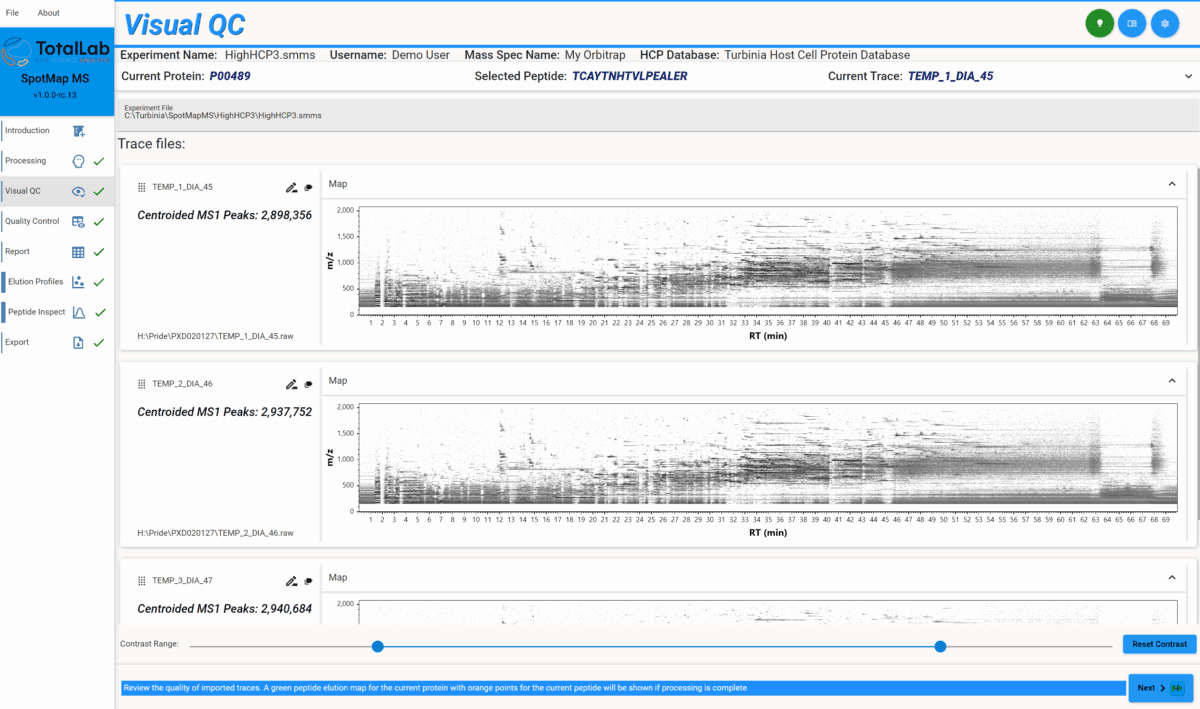
Visual QC built in
Ion intensity maps surface failed technical replicates and acquisition issues before they reach your reported result – supporting the data quality expectations behind the chapter.
21 CFR Part 11 and Annex 11 compliance via AuditSafe
USP <1132.1> alignment covers the method. Operating it in a regulated environment requires a compliant software environment around it. That is what AuditSafe, TotalLab’s universal compliance wrapper, provides.
AuditSafe restricts software and data access through secure user sign-ins and granular permissions, captures full audit logs, supports electronic signatures, and performs image authenticity checks. It wraps SpotMap MS – and any other software in your stack, including third-party tools like Excel, GraphPad and JMP – in a single compliant environment. It is designed to meet:
– FDA 21 CFR Part 11
– USP <1132.1> (Residual Host Cell Protein Measurement in Biopharmaceuticals)
– EudraLex Annex 11
– ISPE GAMP and ALCOA+ data integrity principles
For regulated installations, TotalLab provides an in-person IQ/OQ package as part of the software validation pathway.
What HCP analysts say
“Typically with proteomics-based software to search against the CHO proteome, we don’t have much functionality to validate spectra. As a result, the output becomes ‘here is a list of proteins we identified and their relative abundance’ — if we wanted to validate those matches it could easily take twice as long without SpotMap MS.”
— Senior pharmaceutical analytical scientist
Who this matters to
Pharma QC and analytical development teams moving LC-MS HCP analysis into a regulated, routine setting. Bioprocess development teams who need defensible, risk-ranked HCP data for CMC. CDMOs delivering regulator-ready HCP campaigns for multiple sponsors. Any team whose HCP method has to survive an inspection, not just produce a number.
Frequently asked questions about USP aligned <1132.1> HCP software
Is SpotMap MS compliant with USP <1132.1>?
SpotMap MS is designed against USP <1132.1> – its automated, reproducible LC-MS workflow reflects the way the chapter expects mass spectrometry to be used for residual HCP identification and quantitation. Paired with AuditSafe, it operates in a 21 CFR Part 11 and EudraLex Annex 11 compliant environment. Note that compliance is ultimately a property of your validated process; SpotMap MS and AuditSafe are designed to make achieving and evidencing it straightforward.
How does SpotMap MS achieve 21 CFR Part 11 compliance?
Through AuditSafe, TotalLab’s compliance wrapper. AuditSafe provides secure user authentication, granular permissions, full audit logs, electronic signatures and image authenticity checks around SpotMap MS and the rest of your software stack. It is designed to meet 21 CFR Part 11, EudraLex Annex 11, GAMP and ALCOA+ requirements.
Do you provide IQ/OQ for validation?
Yes. For regulated installations, TotalLab provides can provide an in-person IQ/OQ package as part of the software validation pathway.
What is the difference between USP <1132> and <1132.1>?
USP <1132> covers residual host cell protein measurement generally, long associated with immunoassay-based approaches. The <1132.1> chapter addresses the use of mass spectrometry specifically – using LC-MS to identify and quantify individual host cell proteins rather than provide a single bulk measurement.
Can SpotMap MS handle both identification and quantitation?
Yes. SpotMap MS identifies and quantifies host cell proteins and additionally scores them by published threat level, so you can see not only what is present and at what level, but which residual HCPs carry the most risk.
Does adopting LC-MS mean replacing our HCP ELISA?
No. ELISA and LC-MS are orthogonal techniques and most regulated HCP programs use both. SpotMap MS pairs with PlateLogic and SpotMap 2D so your full orthogonal HCP toolkit sits under one vendor and one compliance framework.
See USP <1132.1>-aligned HCP analysis in action
Book a 30-minute walkthrough with TotalLab, or start a free trial and run a USP <1132.1>-aligned HCP analysis on your own data.