
Western Blot Quantification in 2026: Beyond Excel and ImageJ
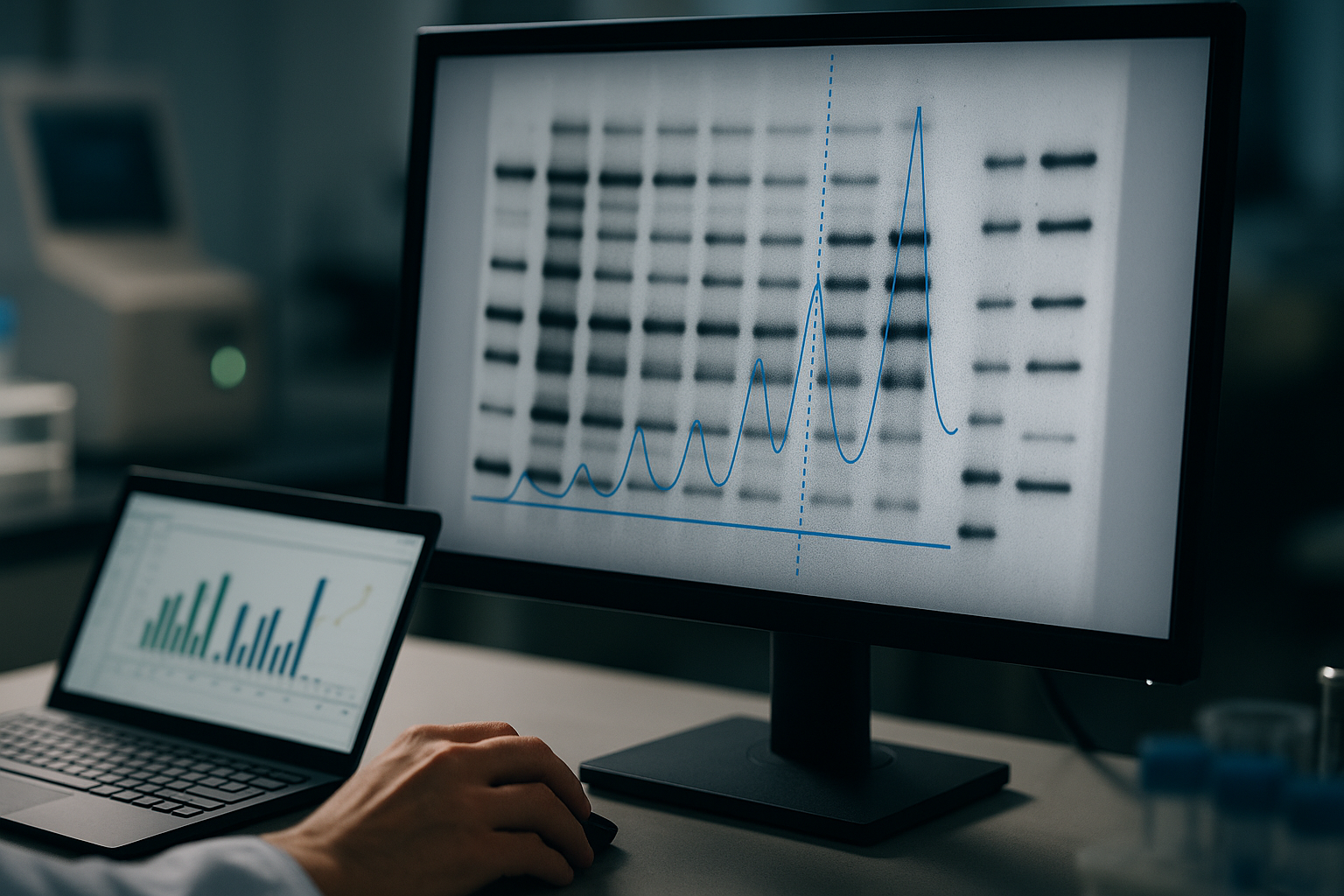
If your western blot workflow still ends with a folder of TIFFs, an ImageJ window, and a spreadsheet full of pasted densitometry values, you already know where the time goes. It is not the science. It is the data wrangling: re-drawing lanes by hand, second-guessing where the background sits, and rebuilding the same figure layout every time a reviewer asks for one more panel.
This guide walks through what that patchwork actually costs you in reproducibility, and how a dedicated platform like Phoretix 1D handles the whole job in a single pass, from raw image to publication-ready PDF.
Why Excel and ImageJ Fall Short for Western Blot Quantification
ImageJ was built as a general-purpose image tool. Excel was built for accounting. Neither was designed for the specific demands of quantifying a blot, and it shows the moment you move past a single clean gel.
The trouble is that every manual step is a decision someone has to make again next week, slightly differently. Where exactly does the lane edge fall? Is that faint signal a real band or noise? Which background value did you subtract last time? Multiply those small judgment calls across an experiment, then across a team, and you get the reproducibility gap that keeps catching people out at review.
Here is how the two approaches compare across a full workflow:
| Step | ImageJ + Excel | Phoretix 1D |
|---|---|---|
| Image import | Manual, no saturation warning, signal direction often ambiguous | Vendor-neutral import, invert function, automatic saturation flagging |
| Lane detection | Draw each region of interest by hand | One click, accommodates bent and non-vertical lanes |
| Background subtraction | One global method, applied manually | Per-lane and per-channel, multiple algorithms, live preview |
| Band detection | Manual peak picking | Automatic with sensitivity presets, plus manual override |
| Molecular weight | Build a standard curve by hand in Excel | Pre-loaded ladders, automatic calibration, multi-ladder anchoring |
| Normalization | Type your own formulas | Built-in reference-band normalization and quantity calibration |
| Reporting | Rebuild figures and tables every time | One-click PDF with images, data, and every setting logged |
| Reproducibility | Depends on who ran it | Templated, identical on every run |
The rest of this guide takes those steps in order.
Getting the Image Right Before You Measure Anything
The first job any quantification tool has is to read the image correctly, and that is harder than it sounds. Different scanners encode signal in opposite directions, so a tool can import your blot and treat the darkest bands as the lowest values without telling you.
“Because our Phoretix 1D software is vendor neutral, we are open to all different file types, all different scanners, but it means that we don’t have as close a link to a specific scanner. So sometimes when we bring images in, the software interprets zeros as ones, ones as zeros. So we don’t know which is high and which is low signal within an image.”
Phoretix 1D’s invert measurements function fixes this in a single step. Better still, the visual display is decoupled from the underlying data, so you can keep the familiar black-bands-on-white view for presentation while the software measures the real signal underneath. No mental gymnastics, no inverted numbers slipping into your results table.
Catching Saturation Before It Skews Your Numbers
Saturated pixels are signal your detector could not actually record. It hit its ceiling, flatlined, and everything above that point is guesswork. Quantify a saturated band and your number is wrong, often badly, and nothing in a raw TIFF tells you it happened.
Phoretix 1D paints saturated areas orange directly on the image, so you can see at a glance which bands exceeded the scanner’s limit of detection and cannot be trusted for quantification. It is the difference between knowing your values sit inside the linear range and hoping they do.
Automated Lane and Band Detection: Replacing Manual Methods
Once the image reads correctly, you need to find the lanes and the bands. This is where manual methods leak the most variability, because it is all eyeballing and dragging.
One-Click Lane Detection
Phoretix 1D detects lanes automatically with a single click. Lanes that lean, bow, or wander off vertical are handled without complaint, and the whole lane gets captured for analysis rather than a guessed-at rectangle. When a gel is badly distorted you can step in and adjust by hand, but most of the time you will not need to. The setup that used to take ten minutes of careful ROI drawing takes a click, and it lands in the same place every time.
Background Subtraction That Adapts to the Gel
Background is rarely uniform. A lens effect, an uneven exposure, or a busy lane can leave one part of the image sitting on a completely different baseline from the rest, and a single global subtraction either over-corrects the clean lanes or under-corrects the messy ones.
Phoretix 1D lets you correct background per lane and per channel, with a choice of algorithms including the rolling ball method, and a live preview of the corrected profile before you commit. You can apply a gentle correction to a clean lane and a heavier one to a noisy neighbour, in the same image, so only real signal feeds into the measurement. For irreplaceable samples, that flexibility is often the difference between salvaging a result and running the experiment again.
Band Detection You Can Actually Trust
Detecting bands across a wide intensity range is where automation usually falls down, picking up noise at the bottom or missing faint signal at the top. Phoretix 1D pairs automatic detection with proper manual control: sensitivity presets tuned for high or low intensity bands, plus the ability to delete a false positive or add a band the algorithm skipped. You get the speed of automation without surrendering the final call.
Quantification, Molecular Weight, and Reporting in One Platform
With lanes and bands locked in and background removed, the analysis moves into the parts that matter most for a result you can publish.
Molecular Weight Calibration From Your Ladder
Phoretix 1D ships with a library of commercial molecular weight markers from the major vendors (Invitrogen, Thermo Fisher, NEB, Bio-Rad), and you can import your own lab-specific ladder templates. Click the marker lane and the software detects the bands, assigns the weights, and builds the calibration curve for you.
Distorted gels get a neat trick. Place a ladder at each side and Phoretix 1D uses both as anchor points:
“It will join those ladders up and use this yellow line in between to use those two ladders as anchor points. Any discrepancy, any warping of the gel, any smiling or frowning will be mathematically removed using those two anchor points on the extremities of the gel.”
So a smiling or frowning gel stops being a reason to re-run, and becomes something the software corrects for.

Normalization and Quantity Calibration
Quantitative work lives or dies on normalization. Phoretix 1D lets you pick reference bands and set your normalization parameters directly, and where you have known standards on the gel, quantity calibration builds a curve and extrapolates absolute amounts for every other band.
Everything lands in one table: band volume, raw volume, background-corrected volume, and normalized values, side by side for you to check. Export it to CSV or copy it to the clipboard, no manual transcription into a spreadsheet required.
Reporting That Documents Itself
The last step is usually the worst one in a manual workflow: rebuilding the figures, re-typing the settings, and hoping you recorded which background method you used three weeks ago. Phoretix 1D generates the whole report from the results tab:
“We can generate a really nice PDF report from this tab, including your images, your settings like your background correction, your band sensitivity settings, everything you’ve used and gathered through this process, to present your results internally, externally, or pass them on to journals.”
Each report carries the original and processed images, the full data tables, the calibration curve, and every parameter you applied. That means the analysis is not just a number, it is a documented record anyone can reproduce, which is exactly what an auditor, a collaborator, or a journal wants to see.
Why Researchers Are Switching From ImageJ to Dedicated Software
It comes down to a few things that a patchwork of free tools cannot give you at the same time:
- Fewer manual errors. Automation takes the repetitive judgment calls off your plate.
- Real reproducibility. Save your settings as a template and every analysis runs identically.
- Time back. Image to finished report in minutes, not an afternoon.
- One dataset, not five. Every measurement, calculation, and figure in a single place.
- Any scanner. Vendor-neutral import handles the common formats from any imaging system.
See It On Your Own Images, Free
The fastest way to judge any of this is to run it on a gel you already know. Phoretix 1D is free to try with no commitment: import your own blot, run a full analysis, and see how quickly you get from raw image to a report you would actually send.
Prefer to watch first? See the full walkthrough on YouTube for a live demonstration of every feature above.