How Azure Biosystems turned imaging hardware into a complete, compliant analysis platform
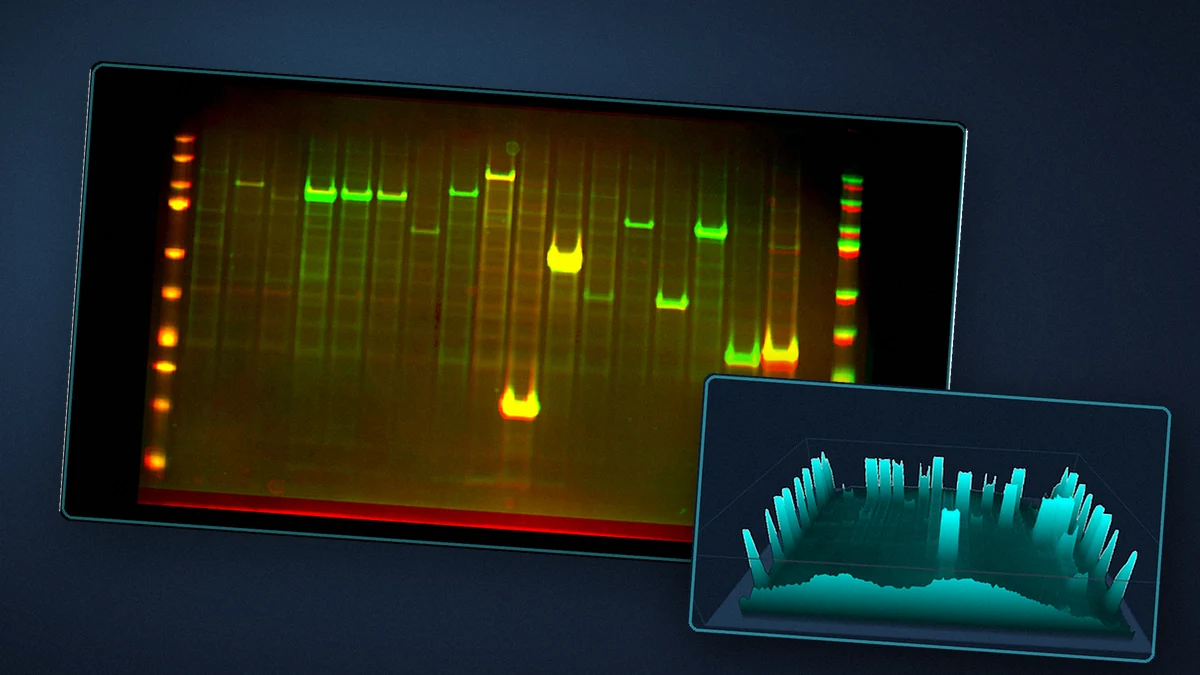

Azure Biosystems builds some of the most capable imaging systems in life science. Their instruments handle chemiluminescent and fluorescent western blots, visible gels, near-infrared detection, phosphor imaging, bacterial plate imaging and model organism imaging. What they wanted next was not better hardware. It was the software that turns an image into an answer.
This is the story of how that software got built, how it became their own branded product, and how it eventually opened the door to the regulated pharmaceutical market.
The problem every imaging manufacturer eventually runs into
You can build a superb imaging system and still lose the sale.
Because the instrument is only half of what the customer is buying. A scientist imaging a western blot does not want an image. They want quantified bands, normalized across channels, with molecular weights assigned and a report they can put in front of a supervisor. A microbiologist does not want a photograph of a plate. They want a colony count they can defend.
If your instrument ships without that layer, one of three things happens. The customer buys a competitor’s system that includes it. The customer buys yours and then buys third-party analysis software, which means someone else owns the part of the workflow your users touch every day. Or the customer buys yours, struggles with a generic tool, and tells their colleagues the instrument was hard to work with.
Azure Biosystems saw this clearly. They had the imaging platform and the applications breadth. What they needed was automated analysis software good enough to sit alongside it, covering the full range of what their instruments were being used for: SDS-PAGE and 1D gels, western blots including multiplex and in-cell western, colony counting, array and micro array analysis, and live animal imaging.
Building that in-house would have meant recruiting a specialist image analysis team, and years of work on algorithms that are far harder to get right than they look. Every hour spent on that is an hour not spent on the hardware that is actually their competitive advantage.
Step one
Prove it with software that already worked
We did not start with a development project. We started with a distribution partnership.
Azure began selling TotalLab’s established analysis software alongside their instruments. It was already mature, already used in demanding pharmaceutical labs worldwide, and already covered the applications their customers cared about. That meant Azure could offer a complete hardware-plus-analysis package almost immediately, with no development spend and no delivery risk.
This step matters, and it is the one most manufacturers skip. It let both sides find out something important before anyone committed to a build: whether their customers actually wanted the software, which parts of it they used, and what they asked for that was not there yet. The commercial answer came back quickly. The bundled offering sold.
Start by proving the demand with software that already exists. Build the bespoke version once you know exactly what your customers reach for.
Step two
Their software, their brand, our technology
With the demand proven, Azure asked the obvious next question. Rather than resell someone else’s software, could they have their own? That became AzureSpot Pro: an Azure-branded image analysis product, built on TotalLab’s analysis technology and two decades of experience in scientific image analysis, and shaped around Azure’s instruments and their customers’ workflows.
The result is software that carries their name, ships with their systems and covers the analysis their users actually do:
- Automatic lane and band detection for 1D gels and blots Multiplex and single-channel analysis
- Background subtraction and saturation detection
- Fluorescent and Chemiluminescent Molecular weight analysis and quantity calibration
- Dot blot and micro array normalization, with grid-based plate and array analysis
- Colony and feature counting on agar plates
- Windows and macOS support, including Apple Silicon (M1/2/3/4/5 processors)
For Azure, the commercial change was significant. The analysis layer stopped being a third party’s product sitting next to their hardware and became part of their own catalogue: their brand on the screen the customer looks at every day, their product page, their upgrade path, and a revenue line that belongs to them. For their customers, it became one supplier and one support route for the whole workflow instead of two.
And they got there without hiring a single image analysis specialist.
Step three
Unlocking the regulated pharmaceutical market
Research labs were only part of the opportunity. The bigger prize was pharma.
Regulated pharmaceutical and QC environments will not accept software that cannot demonstrate compliance with 21 CFR Part 11 and GMP expectations. No audit trail, no electronic signatures, no controlled user access, no sale. For an instrument manufacturer this is a hard wall: it does not matter how good the hardware is, because the customer’s quality department will stop the purchase.
It is also the kind of problem that generalist software teams consistently underestimate. Compliance is not a feature you add at the end. It has to be designed into how records are created, changed, signed and retained, and it has to be documented well enough to survive an inspection years later.
We have been building software to that standard for over a decade, and our compliance technology is in use in the regulatory departments of some of the world’s largest pharmaceutical companies. We delivered a compliant edition of the software for Azure, with the audit trails, access controls, electronic signatures and validation documentation that regulated customers require, plus IQ and OQ so their end users can qualify the installation.
The commercial effect is the part worth paying attention to. Compliance did not just tick a box. It made a whole category of customer available to Azure that had previously been closed to them, on hardware they were already building.
How we make instrument software 21 CFR Part 11 compliant
What another manufacturer should take from this
Three things, and none of them are about Azure specifically:
You do not need a software team to have a software product
Azure now has a branded analysis product in their catalogue. They did not build an image analysis department to get it. If your competitive advantage is optics, chemistry or mechanics, that is where your engineers should stay.
Sequencing removes the risk
Distribute first, build second, comply third. Each stage paid for the next, and nobody made a large bet on an unproven assumption. If you would rather start smaller than a full OEM build, start where Azure started.
Compliance is a market, not a cost
21 CFR Part 11 is usually treated as an expense to be minimized. Treated properly, it is the thing that decides whether you can sell into pharma at all. It is also retrofittable to a product you have already shipped, which is far cheaper than a redesign.
Three ways we work with instrument manufacturers
Distribute
Ship proven analysis software with your instrument Card 1 text: Bundle our established analysis software with your hardware. Fastest route to a complete offering, no development spend, and a genuine test of what your customers want. Card 1 link: Talk to us about bundling
Build
A white-label or co-branded analysis product built on our technology and carrying your name. You own the customer relationship and the upgrade path. We handle development, testing and support.
Comply
Add 21 CFR Part 11, Annex 11 and GMP compliance to software you already ship. Our AuditSafe technology can be retrofitted without redesigning your product.
Why manufacturers bring this to us rather than a generic software agency
We have sold scientific software since 1989, not just written it. Our own analysis products are used in labs worldwide, across gels, blots, arrays, colony counting, LC-MS, proteomics and ATMPs. When we build for you, it is built by people who have spent over two decades learning what works and what doesn’t.
Scientists and mathematicians, not only developers. The hard part of image analysis is not the interface. It is detection, quantification and normalization that hold up under real world, messy data. That is what we have spent two decades on.
Compliance is how we build. Over a decade of 21 CFR Part 11, Annex 11 and GMP work, accepted by the regulatory departments of some of the largest pharmaceutical companies in the world.
Your brand, your customers. OEM work is delivered under your name. The customer relationship is yours, and we stay behind the scenes unless you want us in front of them.
Could we do the same for your instrument?
If any of these sound like your situation, the conversation is worth having.
- Your instrument ships without analysis software, or with software your customers complain about
- Customers are pairing your hardware with a competitor’s or a third party’s analysis tool already
- You want your own branded software but not your own software department
- A pharma or QC customer has asked whether your software is 21 CFR Part 11 compliant, and the honest answer is no
- You have an ageing analysis application that needs rebuilding, securing or bringing up to current standards (such as the EU Cyber Resilience Act)
Book a free 30-minute discovery call. We will look at your instruments, your customers and where the gap is, and give you an honest view of how we would approach it and what it would take. If bundling existing software is the better answer for you, we will say so.
Talk directly to the people who build the software, not a sales rep. Everything under NDA.
Common questions from manufacturers
Do you build software under our brand? Yes. White-label and co-branded OEM software is one of our core services. The product carries your name and ships with your instruments.
Do we have to commit to a full custom build straight away? No, and we usually suggest you do not. Many partnerships start by distributing our existing analysis software alongside your instruments. That proves the demand and tells us exactly what your customers use before anyone commits to a bespoke build.
Our instruments cover several applications. Can one piece of software handle them all? Yes. We build multi-module analysis software covering 1D gels and blots, multiplex and in-cell western, arrays and plates, colony counting and other imaging applications, in a single product with one consistent interface.
Can you make our existing software 21 CFR Part 11 compliant without rebuilding it? In most cases, yes. Our AuditSafe technology is designed to be retrofitted to existing products, adding audit trails, electronic signatures, access control and the documentation regulated customers require, without a redesign.
How long does an OEM project take? It depends on scope, but because we are building on mature analysis technology rather than starting from zero, OEM projects move considerably faster than ground-up development. We will give you a realistic timeline at the proposal stage, not an optimistic one.
We compete with companies you already work with. Is that a problem? We will tell you honestly at the first call if there is a conflict. Confidentiality runs both ways, and we do not carry one client’s work into another’s project.