
Host Cell Protein Resource Hub: Methods, Limits and Software

Host cell proteins are the proteins your production organism makes alongside the product. Purification removes almost all of them. What survives has to be measured, understood and controlled, and the analytical methods used to do that disagree with each other in ways that catch people out.
This page is the map. Each section below explains what a stage of the work involves and links to the page that covers it properly.
For a side-by-side comparison of ELISA, 2D coverage and LC-MS, read our main host cell protein analysis guide. Every other HCP question is indexed below.
Key facts
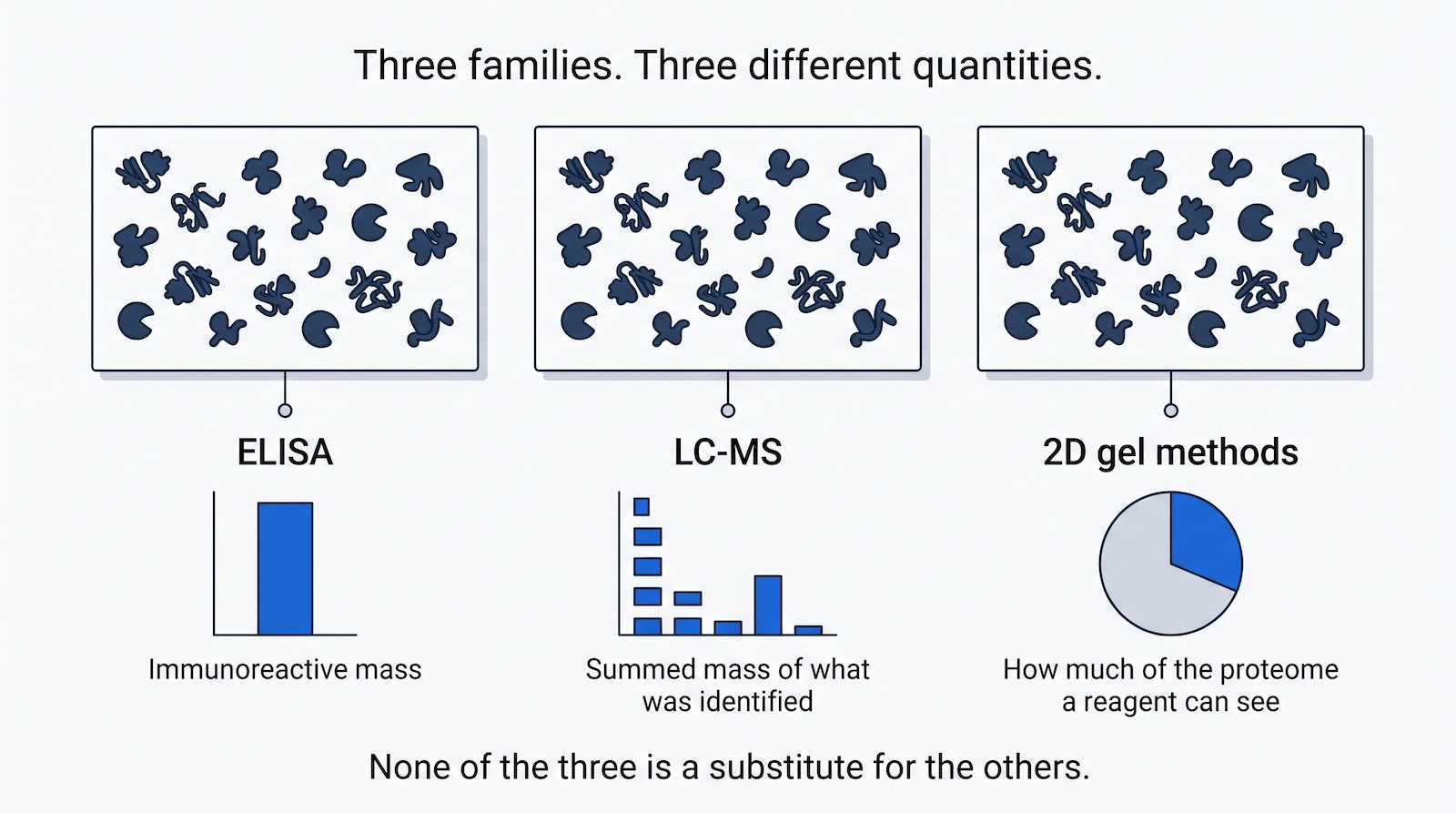
- Three analytical families are in routine use, and they measure different things. ELISA reports immunoreactive mass against a polyclonal antibody. LC-MS reports the summed mass of the proteins it identified and quantified. Two-dimensional gel methods report how much of the host cell proteome a reagent can see. None of the three is a substitute for the others.
- There is no numeric regulatory limit for total HCP. The commonly quoted 100 ng/mg is an industry rule of thumb, not a specification you can cite
- There is no pharmacopeial threshold for anti-HCP antibody coverage either. The bands in use are method-specific and companies set their own
- Concentration and risk are different questions. A batch well inside a total HCP limit can still carry a polysorbate-degrading lipase at parts-per-billion levels and fail on stability two years later
- Two USP general chapters govern the space and they are not symmetrical. <1132> covers immunoassay and scopes gene, cell and tissue therapies out. <1132.1>, official 1 May 2025, covers LC-MS and states that its general principles apply to all biopharmaceuticals, gene therapies included.

Start here
If host cell proteins are new to you, start with the definition and where they come from, then with why they matter commercially and clinically.
Measuring it
Mass spectrometry is where most of the growth is, and where most of the practical questions sit. The pillar page covers the technique end to end. The ppm page covers the arithmetic, which sounds trivial and is not: the denominator you divide by changes the answer, and two labs analyzing one vial routinely disagree by a factor of two.
The acquisition page covers the choice that decides whether your results are reproducible enough to trend across batches at all.
Reconciling the methods
This is where most people arrive. Your ELISA says one number, your LC-MS says another, and someone wants to know which one goes in the filing.
The short answer is that they measure different quantities and are not expected to agree. The long answer involves antibody coverage, which is its own contested subject with no agreed threshold and a thirty-point spread between methods.
Which host cell proteins carry risk
A total number tells you how much is there. It does not tell you whether any of it matters. BioPhorum’s four impact categories are the working framework, and there is a named list of offenders behind them with primary citations attached.
What the regulations ask
USP General Chapter <1132.1> is informational rather than mandatory, which means it is guidance you are expected to have considered when you justify your control strategy. Its three quantitation methods are numbered 5.1.1, 5.1.2 and 5.1.3, not lettered A, B and C, whatever the conference slides say.
Separately, the software layer carries its own obligations once the result is a regulated record.
Viral vectors and gene therapy
The monoclonal antibody playbook does not transfer. There is no null cell line, the product protein is a multi-subunit capsid, the sample volumes are tiny, and the field has not agreed what the ppm denominator should even be.
Software, and bringing the work in-house
Most laboratories can run the instrument. The bottleneck is the analysis layer: identification thresholds, false discovery rate control in a sample with a million-fold dynamic range, shared peptide assignment, and producing a result somebody can defend twelve months later.
The whole cluster, by the question it answers
| The question you arrived with | Where it is answered | Stage |
|---|---|---|
| What is a host cell protein, and where do they come from? | What is a host cell protein | Start here |
| Why does HCP matter in a biologic at all? | Host cell protein (HCP) analysis in biologics | Start here |
| How is HCP measured by LC-MS? | LC-MS HCP analysis | Measuring it |
| How is HCP ppm actually calculated? | How HCP ppm is calculated from LC-MS data | Measuring it |
| How does Hi3 label-free quantitation work? | Hi3 peptide quantification for HCP analysis | Measuring it |
| Should I acquire in DIA or DDA? | DIA vs DDA for host cell protein analysis | Measuring it |
| Can the analysis be automated? | Automated HCP analysis workflow | Measuring it |
| My ELISA and LC-MS numbers disagree. Which is right? | HCP ELISA vs LC-MS results | Reconciling methods |
| What antibody coverage percentage is acceptable? | HCP antibody coverage percentage | Reconciling methods |
| How is coverage measured on a 2D western blot? | HCP coverage analysis using 2D western blot | Reconciling methods |
| Why do I need to know my antibody coverage? | HCP antibody coverage and ELISA validation | Reconciling methods |
| Which host cell proteins actually cause harm? | High-risk host cell proteins | Risk |
| How does software flag a high-risk HCP? | How SpotMap MS identifies high-risk HCPs | Risk |
| What does USP 1132.1 ask me to do? | USP 1132.1 quantitation methods | Regulatory |
| What does my software need to satisfy USP 1132.1? | USP 1132.1 HCP software | Regulatory |
| What does 21 CFR Part 11 require of the analysis? | 21 CFR Part 11 compliance overlay | Regulatory |
| Does any of this transfer to AAV and gene therapy? | Residual protein analysis for AAV and gene therapy | By modality |
| How does SpotMap MS compare to proteomics tools? | LC-MS HCP software comparison | Software |
| What makes proteomics software validated? | Validated proteomics software | Software |
| Should I bring HCP analysis in-house? | Bring HCP analysis in-house | Software |
Every page in the TotalLab host cell protein cluster, indexed by the question it answers.
Where TotalLab fits
TotalLab builds the analysis software, not the assays. SpotMap MS turns LC-MS data into host cell protein results without requiring a proteomics specialist to drive it. SpotMap 2D measures antibody coverage on 2D gels and western blots. AuditSafe adds the audit trail, electronic signatures and permissions that make either one usable as a regulated record.
Start with your own data
Every page above describes a decision somebody has to make on real data. The fastest way to find out whether the tooling fits your workflow is to put one of your own files through it.