Article
Java4Shell: AI Found a Critical Java Flaw in an Hour.
Is Your Lab's Image Analysis Workflow Next?
Article
Is Your Lab's Image Analysis Workflow Next?
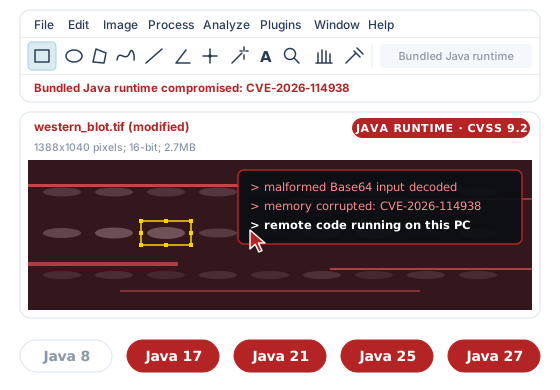
On November 17, 2026, security firm Calif disclosed Java4Shell (CVE-2026-114938), a critical flaw in OpenJDK. A researcher using an AI coding assistant found it in about an hour and built a working exploit in two more, for under $200. For labs that run ImageJ or Fiji, both built on Java, it raises one question: when the next flaw lands, who fixes it for you?
The flaw sits in Java's Base64 decoder, one of the most used utilities in the language. Calif rated it 9.2 under CVSS 4.0: on certain inputs it corrupts memory and can let an unauthenticated attacker run code remotely. It affects OpenJDK 17.0.6 and later (Java 17, 21, 25 and 27) and the major distributions built on it, on x86-64 processors with AVX-512 VBMI support. Oracle and OpenJDK shipped fixes the same day.
Java4Shell is the headline, not the whole story. October's quarterly OpenJDK update fixed 53 vulnerabilities, which Azul called an all-time high. IBM and Red Hat's AI-assisted Lightwell program found more than 400 more in widely used Java libraries. AI is finding old bugs faster than anyone planned for, and attackers have the same tools.
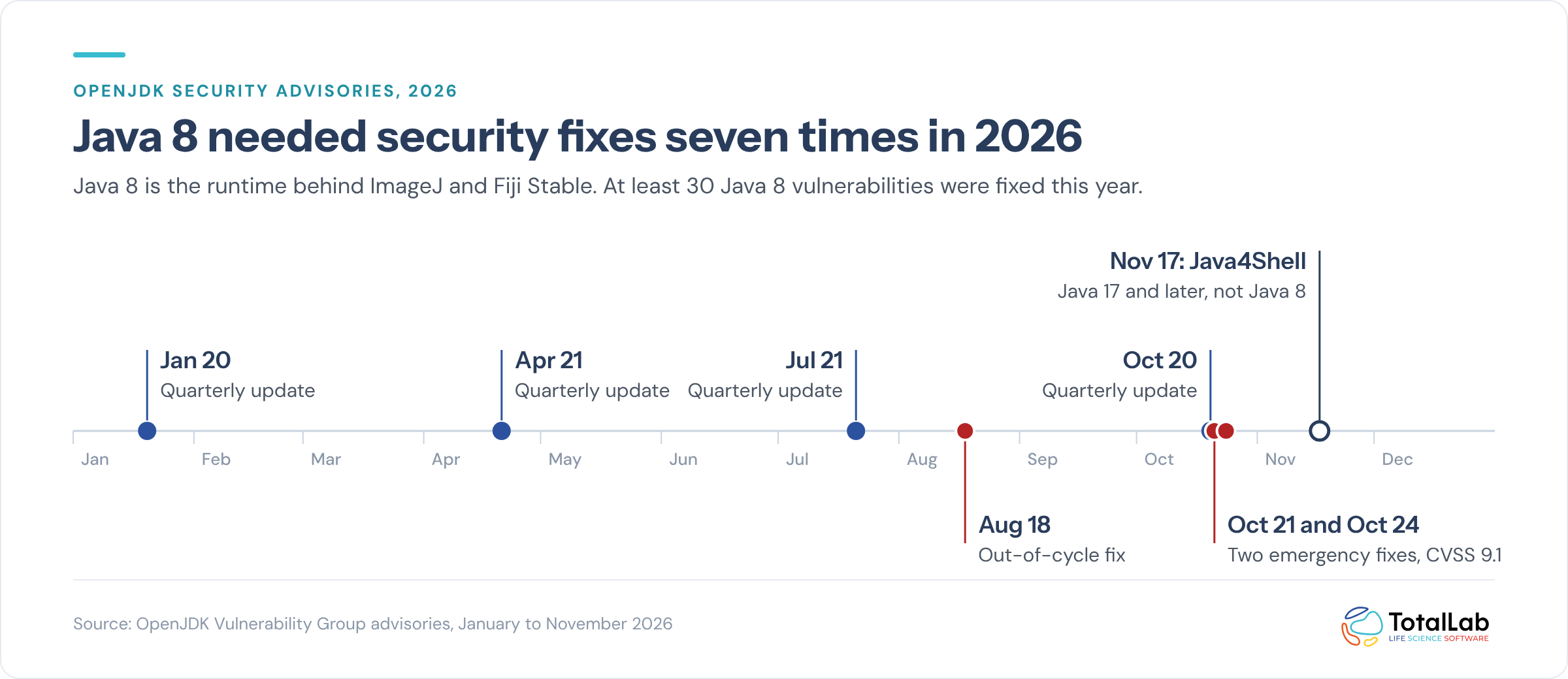
Java4Shell missed Java 8, the runtime behind ImageJ and Fiji Stable. Java 8 has not been spared, though: OpenJDK has fixed at least 30 Java 8 vulnerabilities in 2026, across seven advisories. The question is not whether the next flaw will be found. It is when.
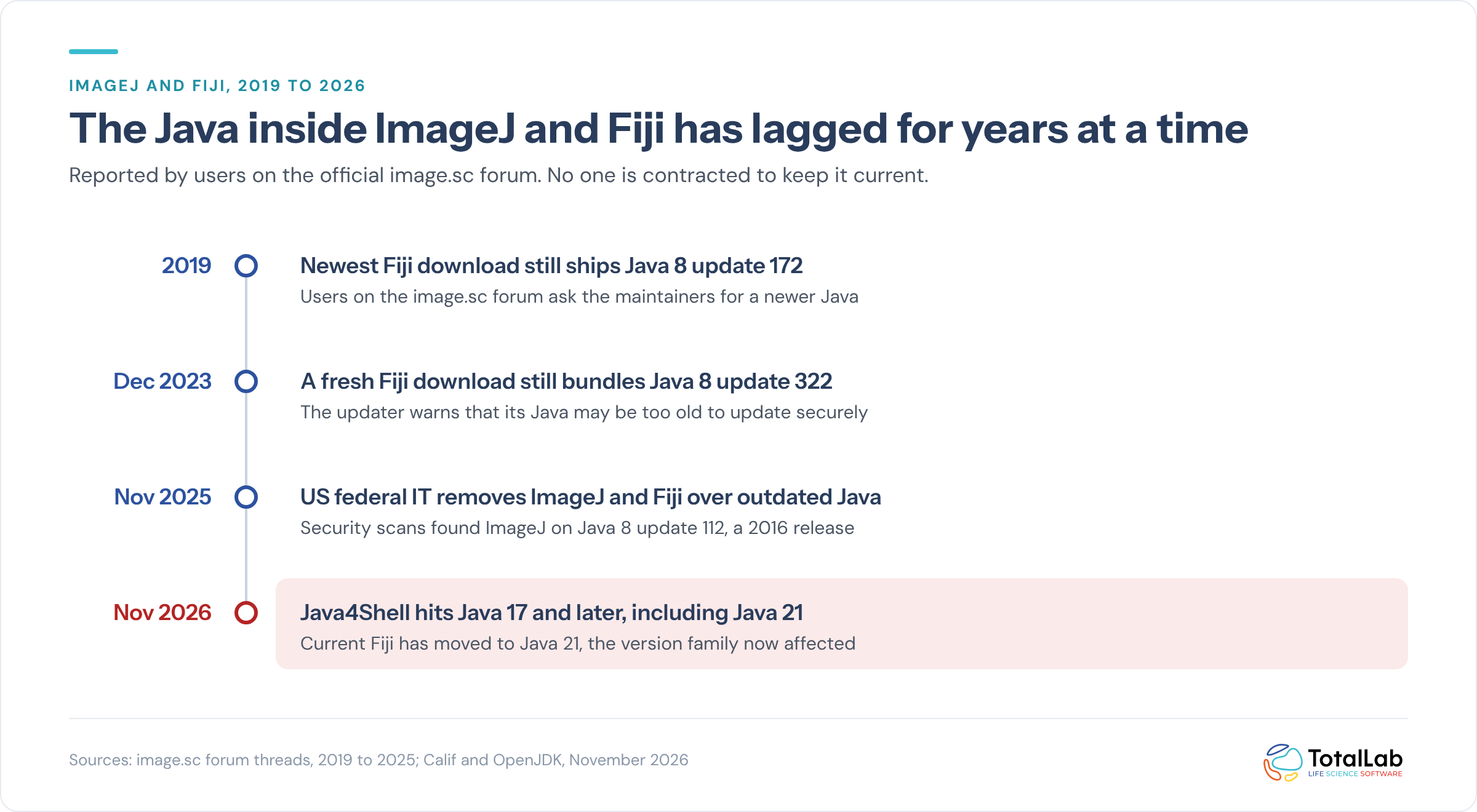
ImageJ and Fiji carry their own copy of Java, and Fiji looks in its own folder first. A corporate patching tool that updates the system Java may never touch it. The maintainers do respond when problems are reported: they replaced flagged components in 2025, and current Fiji has moved to Java 21. But the fixes have followed user reports on a public forum, and Java 21 is exactly the version family Java4Shell has just hit. There is no public report of Java4Shell being used against ImageJ or Fiji.
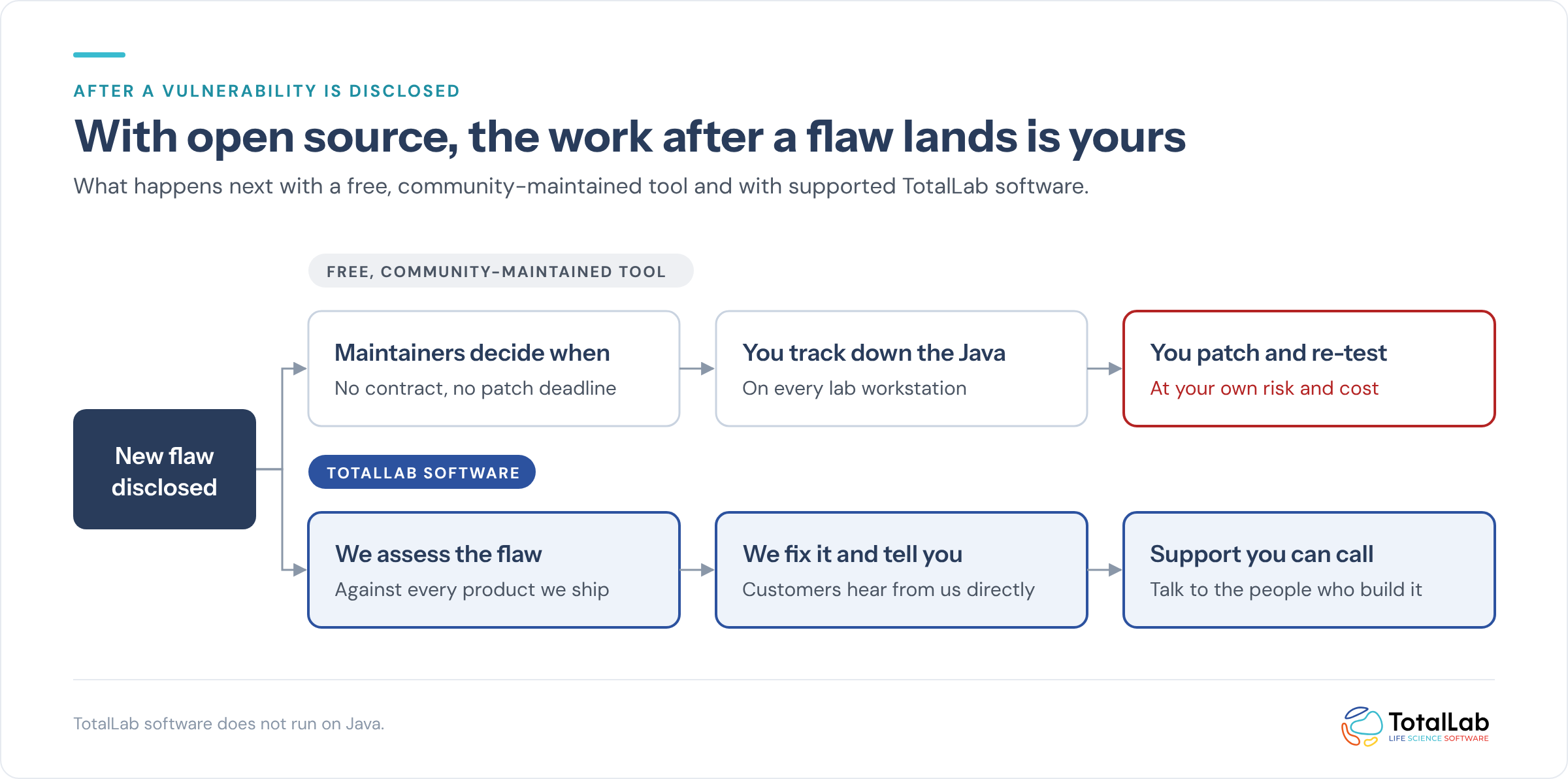
ImageJ and Fiji are excellent free tools, maintained by academic and community developers. Their open-source licenses provide the software as is, without warranty. There is no support contract, no patch timeline and no one obliged to answer when a critical flaw is disclosed. Finding the runtime, patching every workstation and re-validating the tool all fall to you.
Picture a regulated lab on a Monday morning. A critical Java flaw was disclosed over the weekend, and IT's scanners have flagged the runtime inside every Fiji installation. IT does what one US federal agency did in 2025 and pulls the software. Which assays stop? Which batch release is waiting on images nobody can analyze? Who re-validates the macros your methods depend on? And who do you call?
The cost of getting it wrong is real. In 2017, NotPetya infected more than 40,000 of Merck's machines, spreading through systems that lacked a security patch; Merck put its losses at $1.4 billion. In May 2026, ransomware forced West Pharmaceutical Services to shut down systems globally, disrupting manufacturing and shipping. Dragos counted 46 ransomware incidents against pharmaceutical manufacturers in the third quarter of 2026, up from 19 in the first. IBM puts the average breach at $11.5 million in the United States, and healthcare has been the costliest industry for 13 years running.
Attackers need one gap. Nobody can rule out an out-of-date Java runtime on a lab workstation that IT does not even know is there. On one side is a free tool with nobody accountable for its security. On the other is a breach that costs millions and stops production. Is saving on a license worth that?
Our development teams have been building life science software since 1989. None of our software runs on Java. Every product is licensed and supported by the team that writes it, so there is a named supplier your QA team can audit and a support team you can call.
No software is immune to vulnerabilities. The difference is who fixes them. Our developers track newly disclosed vulnerabilities, including the new wave being found by AI. When an issue affects our software, we fix it and tell our customers. We also help other software companies meet the EU Cyber Resilience Act, and we hold our own products to the same standard.
For the work labs most often do in ImageJ, there is a TotalLab tool: Phoretix Toolbox for general image measurement and quantification, Phoretix 1D for gels and western blots, Phoretix Colony Counter, Phoretix Array, SameSpots for 2D gels and SpotMap 2D for host cell protein coverage. With AuditSafe, TotalLab software provides audit trails, electronic signatures, granular user permissions and image authenticity verification for FDA 21 CFR Part 11 and EU Annex 11. Our custom development team can turn ImageJ macros into supported, validated software.
Patch Java now: the November 17 updates are out from every major Java distributor. Then find every tool in your lab that carries its own runtime and ask who owns it. When you are ready to move regulated image analysis onto supported software, start a free 7-day Phoretix 1D trial or contact us at info@totallab.com or +44 191 255 8899.
Your software won't do what you need? Ask TotalLab →Tell us the problem; we reply within two working days.